

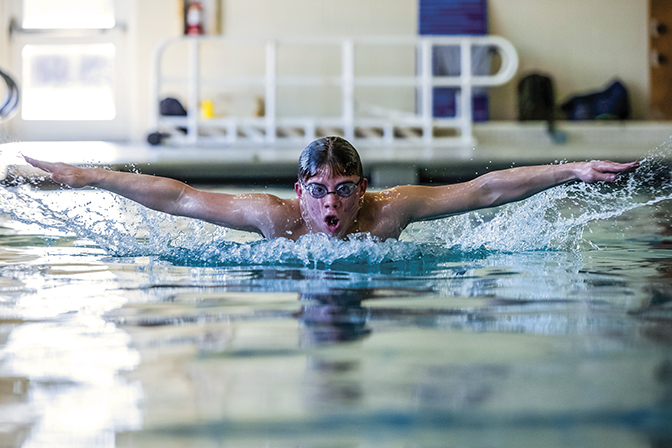
In the 1930s, one of Oscar Gunkler’s earliest assignments at Berea College was to administer swim screenings. In his memoir, “May I Say A Few Words?” Gunkler, the namesake for Berea College’s natatorium, recalled witnessing a student hesitant to get in the water during one of these screenings. Once in the water, the student started flailing and struggling. With his student instructors frozen, Gunkler jumped into action.
“I handed my clipboard to the instructor nearest me, and clothes and all, dived into the pool,” he wrote. “While pulling the man to the side of the pool, I said, ‘What’s the matter, son, can’t you swim?’ After several gulps of air, he said, ‘Don’t know. Never tried.’ Needless to say, he quickly learned how to swim.
As a matter of fact, after instruction and practice, he made the swimming team.”
To this day, Gunkler Natatorium is loved by many for the pool it holds and dreaded by some for the anticipated required swim screening needed to graduate. On the surface, it may seem like a regular pool, but its deep waters contain a vast history.
In the early 1900s, there was a rise in drownings across the nation. Many colleges decided to make learning to swim a graduation requirement. As time went on, this requirement began to vanish, but it remains in some colleges today, such as MIT, Cornell and Berea.
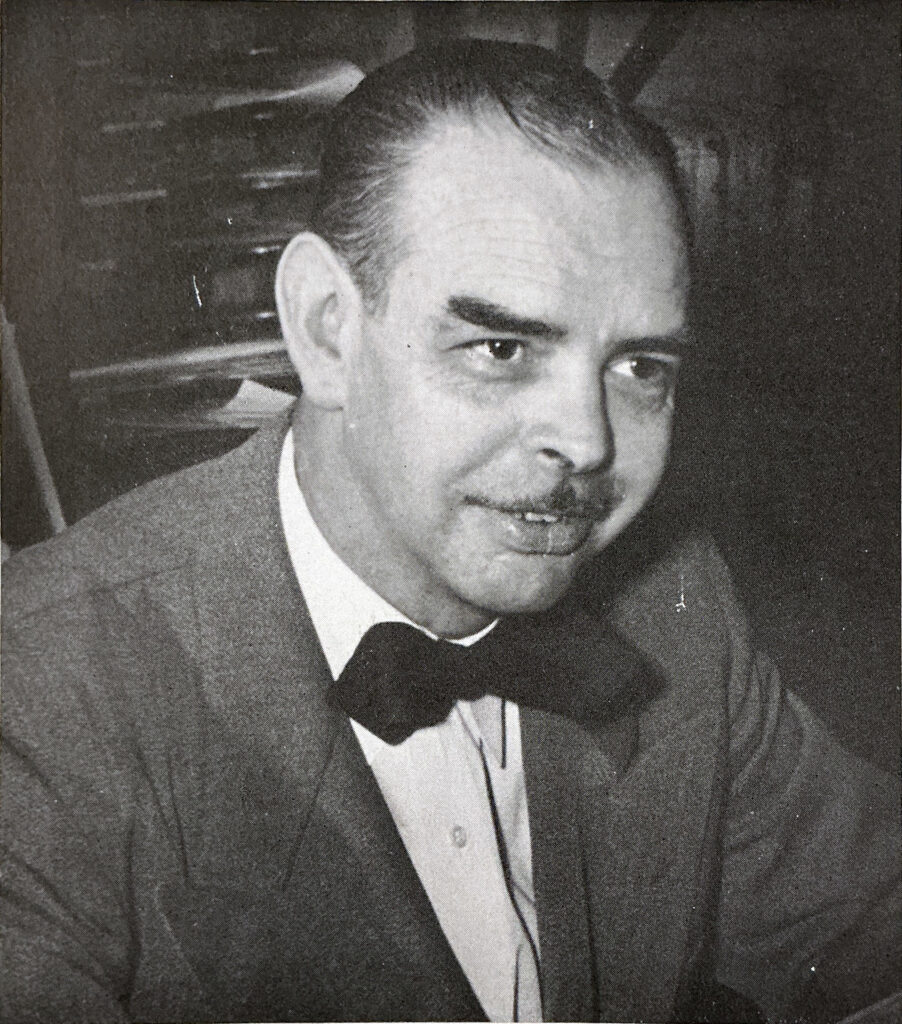
Photo courtesy of Berea College Special Collections and Archives
When Gunkler arrived in Berea as the College’s athletics director in 1930, not many athletic programs were offered, let alone swimming courses. The Seabury Center—called the Seabury Gymnasium at the time—was newly built, and Berea was one of the first institutions in Kentucky to have a full-fledged educational swimming facility. The Seabury Gymnasium gave Gunkler a place to encourage students to strengthen not only their bodies, but also their minds.
Gunkler introduced the College to soccer, dance and swimming. He saw the pool as a teaching setting and a stage. Gunkler taught survival swimming and advanced swimming and hosted aquacades, which are synchronized swimming performances. “Extensive training in swimming can be boring. I sought ways to alleviate this drudgery by putting on water shows,” Gunkler further recalled in his memoir.
Today, Berea College’s Seabury Gymnasium has transformed into a sports complex with multiple classrooms, a weight and cardio room and an even larger pool—dedicated to Gunkler in memoriam of his contributions as athletics director.
Thanks to Gunkler, students, past and present, have transformed their lives by learning how to move not only on land but in the water. The Seabury Center has enriched the lives of many by offering a place to learn how to swim and continues to do so to this day.
The swim requirement for students to graduate today has remained unchanged for the past 20 years, adhering to the Red Cross swim competency requirements. Every student must pass the swim screening to graduate, and if unable to do so, they can learn another essential skill to fulfill the requirement, such as CPR (cardiopulmonary resuscitation).
Berea College’s swim competency requirement is not just a graduation requirement but an emphasis on the College’s liberal arts model. Students are encouraged to learn new subjects and skills, and swimming opens many doors for them to explore activities they never thought they could. Berea College employs a variety of staff to prepare students with these skills today.
Arriving in 2024, Berea College Aquatics Director Sean Trinque has an extensive history in athletics, including mountain biking and coaching swim. Trinque believes, as many other aquatics faculty do, that swimming is a crucial skill. “You don’t have to learn how to ride a bike, but when it comes to swimming, it’s a survival skill,” Trinque said. “Seventy percent of the Earth is water, so you might fall into it.”
After taking survival swimming, some students choose to progress into more advanced classes. Professor of Engineering Technology and Applied Design (ETAD) Gary Mahoney ’82, who holds the Laban T. and LaVerna R. McClure Chair in Technology and Industrial Arts, also teaches scuba diving. Students who have passed the swim screening and taken the course have been able to travel the world to explore and survey the deep.
“I’ve had students that came to Berea College that couldn’t swim at all that would take the beginning swim class and have signed up for [Scuba], gone to Honduras with us, and would dive 35 dives or so while we’re down there,” Mahoney said.
Trinque also recalled a student who went on to pursue greater swimming activities. After taking survival swimming with Trinque, the student went on to take intermediate swimming, scuba diving with Mahoney, and then went on to scuba dive in the Bahamas. “Swimming has now changed this student’s life,” Trinque said.
Berea College aims to equip students for the future by breaking generational cycles. Swim Screening Coordinator and Health and Human Performance (HHP) Professor Melody Srsic has worked at Berea for 20 years, testing skills and teaching hundreds of students how to swim. As many swim faculty know first-hand, teaching these students has changed their future, and other people’s futures immensely.
“I think here at Berea College, as part of our mission, the College very successfully breaks barriers and increases accessibility to our students who may not have had access to these experiences before,” Srsic said. “We’re very good at it, and thanks to the students who are willing to swim, we break cycles of generational fear in the family.”
Students pass down what they have learned from survival swimming, teaching it to their friends and loved ones. “I often hear back from graduates who have become parents, say, ‘My kids are also now in swimming lessons,’” Srsic recalled. “‘My kids will not become a drowning statistic. We all know how to swim.’”
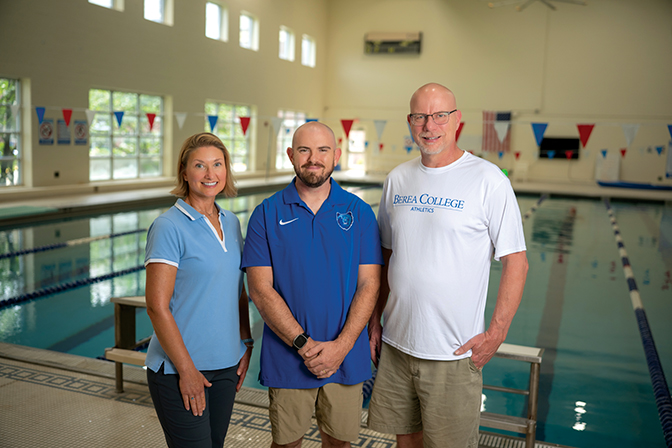
Photo by Timothy Housa ’27
Diving Deeper
Berea College’s former Dean of Curriculum Scott Steele re-earned his certification, and will teach survival swimming in 2027. Steele has an extensive background in swimming, coming from Texas Christian University (TCU) as a Division I swimmer and coach. “I was a swim coach. I was [also a] competitive swimmer, but I’ve never taught swimming or survival swimming to adults,” Steele said.
Steele believes, as many faculty do, that the swim requirement is an essential part of Berea College’s liberal arts model. “We recently did a general education review, and swimming is really part of the general education,” Steele said. “And at that time, the faculty agreed to keep it, to make it an expectation for our students.”
For Steele, the most rewarding part of being a swimming coach is the impact of his work. “Teaching is rewarding,” Steele said. “I’ve heard both from the instructors and from the students that students are very grateful that they had the opportunity to develop this skill that they can use their whole life, and they really enjoy it. So, when you’re teaching something that someone really is appreciative of learning, I think that’s very gratifying.”