
Swinging slowly and silently, the pendulum in the Margaret A. Cargill Natural Sciences and Health (MAC) Building cuts through the air, carving a path through the sand beneath. As it swings, it serves as a metaphorical reminder of a journey we all take over time, one of learning and of growth. At Berea College, this change through time is echoed in the evolution of its programs.
“I still have a brick from the old science building. It’s right there,” Dr. Megan Hoffman, professor of biology at Berea College, said as she pointed to the windowsill in her office.
The old brick sits idly, with a little potted plant on top of it, soaking up the sun shining through the glass. A bee whizzes around on the other side of the pane.
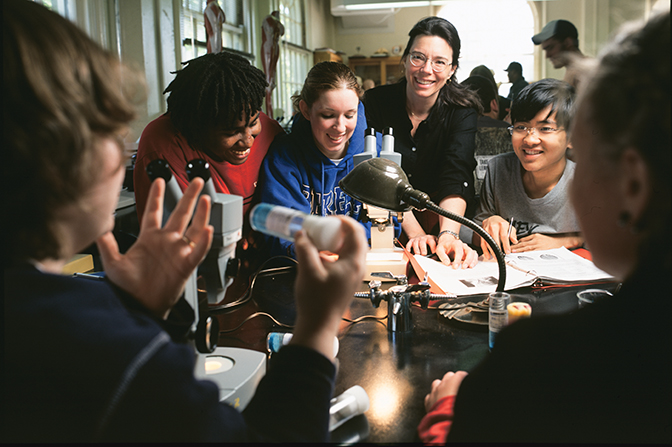
Photo taken in 2006 by O’Neil Arnold ’85
The old science building, Hall Science, was constructed in the 1920s, renovated in the 1980s and replaced in 2018. Hoffman vividly described the old building as a beautiful piece of architecture at the center of campus on the Quad, where the Communication, Media and Information Technology building (CMIT) stands today—from the hardwood used in its construction, to a colorful stained-glass window and even the distinct lack of air conditioning.
The building also had a pendulum.
The specific type of pendulum used in both Hall Science and the MAC building, a Foucault pendulum, demonstrates the rotation of the Earth. As it swings, it creates a line in the sand beneath it. The Earth rotates around it, allowing the pendulum to create more lines in the sand until it arrives at the same line it started in—all without having rotated on its own. The pendulum serves as a representation of days passing by. On Berea’s campus, this can be felt as the College evolves through the years, with new buildings, new programs and classes and new ways to experience Berea.
By the time Hoffman arrived on campus in 1994, Hall Science was struggling to keep up with technology. As vital modern systems like air conditioning and computing systems were placed around the building piecemeal, classroom by classroom, it became clear the hall might be unworkable.
“Finally, they put air conditioning in the last lab. They were like airplane engines,” she recalled. “There was a giant support in the middle of the room, so I couldn’t see everybody while I was teaching. It was bizarre. Technology outpaced the building.”
Hall Science also had a telescope—an amenity that was moved off-campus during the transition to the MAC building. An amenity that remained, however, is the planetarium.
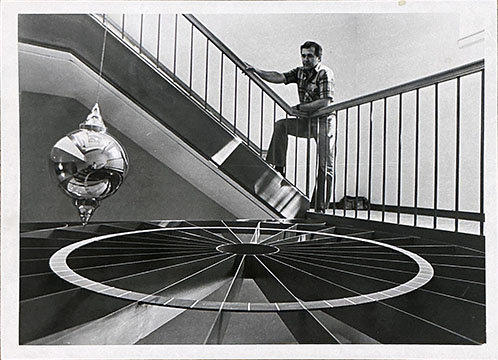
Photo courtesy of Berea College Special Collections and Archives
The College had a state-of-the-art planetarium in the 1980s, a projector that used slides. Nowadays, the Yahng Discovery Center in the MAC building runs a planetarium that’s more modern and digital.
The transition from Hall Science to the MAC building is not the only aspect of the science program that has changed. Hoffman said advancements in technology and breakthroughs in various fields have incentivized the science departments at Berea to change and grow their programs. “In the 30 years I’ve been here, everything in the field has changed so much,” Hoffman said. “It’s completely different. We’ve been adjusting our classes over the years to meet this change.”
As experienced professors retire, new professors are hired, bringing in a fresh understanding of their fields in science and helping the science departments at Berea evolve and adapt to new discoveries. All the while, the pendulum continues to swing in the MAC building, as it had in Hall Science. As Hoffman reflected on her time in Hall Science, she also made clear the improvements the MAC building made.
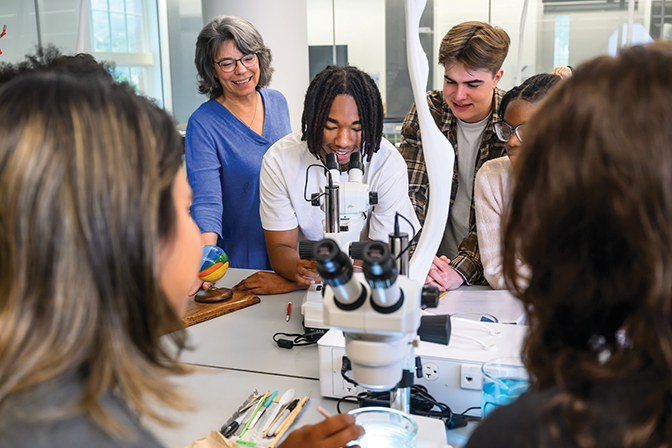
The MAC building has two layers of its interior: an outer layer of classrooms and offices, and an inner layer with glass walls showcasing labs and larger classrooms. The glass walls make it possible to see in action the practical applications of the sciences Berea offers.
“I love being able to see my biology students in their other classes,” Hoffman said. “Seeing students at the lab bench and reading the board to see what they’re working on; that was part of what we wanted to do with this new building: to see science as science is.”
With the movement of the pendulum, days turn into years on Berea College’s campus. Change is natural. Eventually, things change in some way through time. This is clear with Berea’s campus: new buildings bring new opportunities for growth, learning and new experiences.
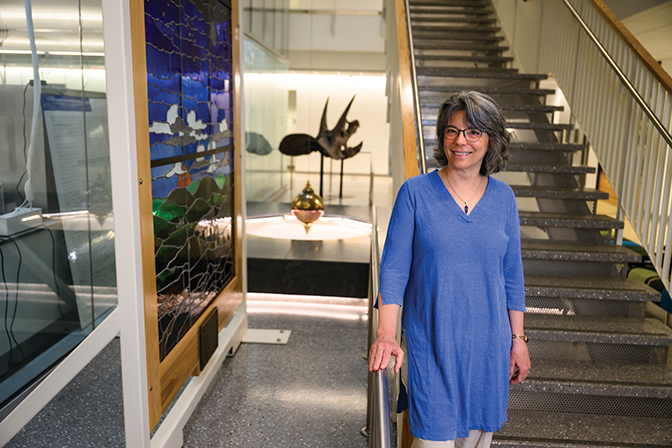
Photo by Crystal Wylie ’05
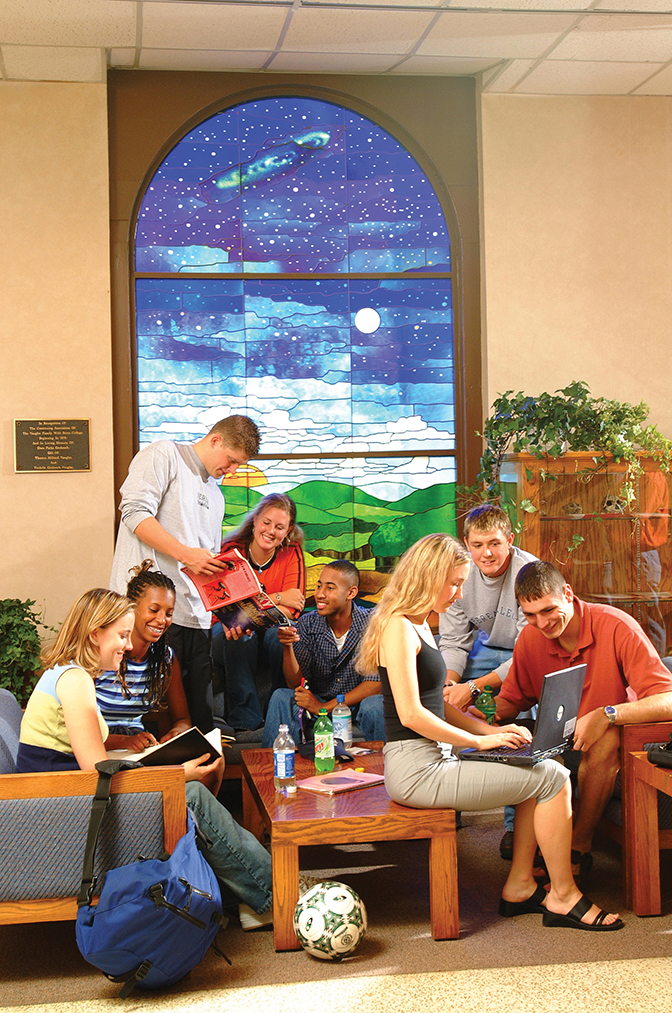
FROM THE ARCHIVES
A 2001 photo features students sitting in the Hall Science lobby in front of a stained-glass window that is now displayed on the ground floor of the new Margaret A. Cargill Health and Natural Sciences Building. The stained-glass piece can be seen in the background of the photo above.
Photo by Berea College Public Relations Archives