
For Seth Lewis ’15, his first semester at Berea was nearly his last. Going through a difficult time in his life, he had every intention of dropping out.
He walked into his labor supervisor, Jeffrey Linville’s, office resolved to let him know. His supervisor, though, simply replied, “Sit down, Seth—no, you’re not.”
“That was all it took. I stayed all four years. Best decision I’ve ever made,” Lewis recalls.
Lewis held a few labor positions during his time at Berea, from a desk job in the Loyal Jones Appalachian Center, to working on the farm, to serving as a teaching assistant. It was his position in facilities management that he looked back on with the most clarity.
“For two years, all those people you see setting up chairs and tables for events around campus, that was
me,” Lewis said. “I loved that job and my supervisor.”
Lewis is no stranger to hard work. He descended from a family of Appalachian miners, but he was determined to break this tradition when he applied to Berea. His various labor positions helped to clarify how he felt about his home.
“For five hours a week, I worked in the Appalachian Center,” Lewis explained. “On top of that, I worked on the farm. Despite my Papaw being a coal miner and a farmer, I had not done much farm work. Those two jobs specifically helped root me to my place in my land, and I continue farming now to this day.”

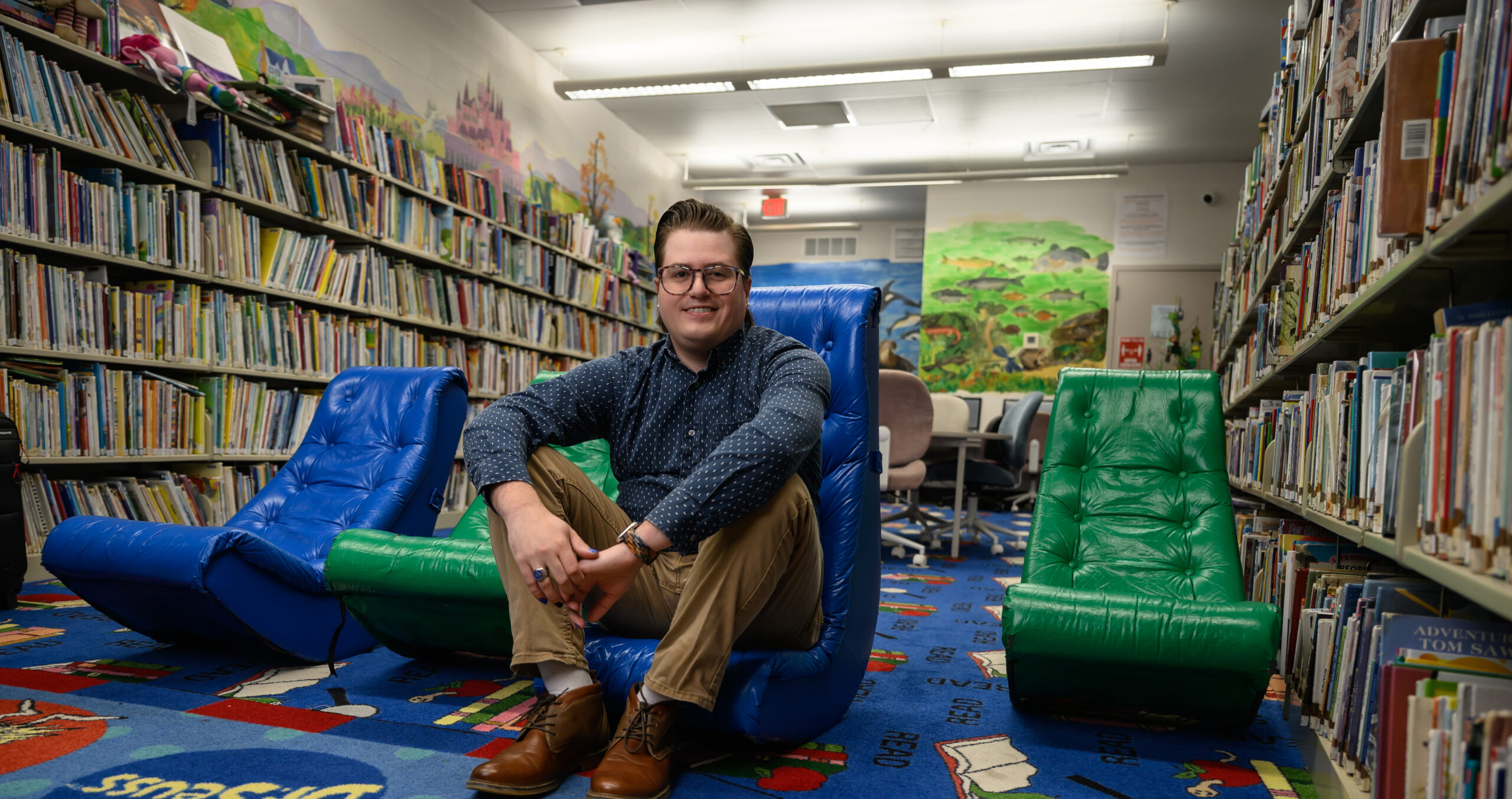
During the magazine photo shoot, Lewis and photographer Crystal Wylie ’05 realized she had photographed him more than a decade earlier for a Berea College Admissions billboard campaign. The project featured students from 12 recruitment regions, with billboards displayed in their hometowns; Seth’s ran in Hazard from October 2016 through March 2017.
After deciding to stay at Berea, Lewis began giving back to the Appalachian region, starting with his
campus community.
Lewis was one of the founders of the Appalachian Student Union, a student organization still strong
on campus to this day, serving Appalachian students and providing educational opportunities about the region.
“Some other folks from the Appalachian Center and I realized that there was no group on campus that catered specifically to Appalachian students,” Lewis said. “This being an Appalachian institution, we felt like there was a real need for there to be a student organization for that. We took the handle and made it ourselves.”
Berea has a strong connection to Appalachia, rooted in its Great Commitments. Today, Lewis continues to embody the same commitments that Berea has to Appalachia in his work as coordinator of the Ready-to-Work program in Hazard, Kentucky.
“I came to school, and I turned right around and moved back home,” he said.
The Ready to Work program is a partnership between the Kentucky Community and Technical College System (KCTCS) and the Department of Community-Based Services (DCBS), where low-income individuals pursuing higher education can be supported economically.
The program partners with students receiving food stamps and KTAP, or Kentucky Transitional Assistance Program, funding. A condition of KTAP funding is labor, which could take the form of volunteer work or employment. Ready to Work helps students fulfill that requirement by placing them in jobs and volunteer positions.
“Our students get their education, and they get paid through us,” Lewis explained. “It’s a win-win situation. Instead of just getting to volunteer and just get the KTAP, you get the KTAP, you get the food stamps, you get your education and you get paid. It’s supposed to be a step to help lift families out of generational poverty, and I think it really does that when they take advantage of it in the right way.”
Lewis says his experience with balancing labor and classes at Berea has been vital in connecting with the students he’s supporting.
“I tell the students all the time: ‘I know exactly what you’re doing. I also worked 20 hours a week and went to school at the same time. I know what it’s like,’ so that gives me the ability to connect with these students.”
In addition to his student work experience, he also continues to adapt his training in political science and history to help better serve the students he guides. Owing to the liberal arts model of Berea, his education applies to a wide range of situations he faces in his work today.
“History taught me how to unpack specific stories and how to look at them with nuance,” Lewis said. “Political science taught me how to zoom out and look at them with a broad perspective.”
Lewis spoke at length on the issues facing the Appalachian region. The Ready to Work program has given countless Appalachian people the opportunity to regain control of their lives, crucially, for themselves and on their own terms.
“When you show people that they have independence, after they’ve been nothing but beaten down the whole time, whether that be circumstances or decisions or what have you, that’s a very powerful and freeing thing,” Lewis said.
Lewis implored fellow Appalachian people to be conscious of the troubles faced by the region, from the opioid epidemic to poverty. In a place as rooted in community as Appalachia, there are seldom more important things than sticking together through hardship, Lewis says.
“More people need to come home,” Lewis implored. “If you want to fix it, be part of the solution.”