
The Berea connection extends beyond the confines of campus and graduation years. Such is the case for three Berea alumni who connected over their shared affinity for the College as they pursued law careers: Robert Lawson ’60, William Davis ’74 and Emily Puckett ’07.
Throughout his career as a lawyer and law professor, Lawson has written code that set the standard for others in the field and impacted the lives of more than 6,000 students. Davis and Puckett are among those students and owe their own connection to Lawson.
Growing up as the son of a coal miner in the Whitman Creek community of Logan, West Virginia, Lawson thought he had no chance of going to college. His mom and aunt learned of Berea College, a place where Appalachian students like Lawson could access higher education at no cost.
“It was a miracle, actually,” Lawson said. “Berea ended up being the only way I could go to college.”
I owe everything to Berea College.
Robert Lawson ’60
Following in his older brother, Earl’s, footsteps, Lawson came to Berea in 1956 to study economics and business. He met his wife, Rosemary, a couple of years later at an orientation event at the College.
While on campus, Lawson had several jobs. He worked in the business office, the grocery store, as a janitor, swim instructor and eventually as a teaching assistant for his German professor.
“Everything was special [about Berea]—my classes, the professors, the students,” he recalled. “It was a good place.”
Lawson excelled while at Berea. He earned good enough grades and enjoyed the college experience so much that he wanted to further his business education in graduate school. However, a scholarship opportunity would change the trajectory of his career.
Berea offered Lawson a full-tuition scholarship to Tulane University’s law school. He hadn’t considered a career in law before, but the opportunity was too good to pass up, so he and Rosemary got married and moved to New Orleans.
Lawson quickly realized he wouldn’t want to practice law in Louisiana, though, and the couple moved back to Kentucky. Lawson started his second year of law school at the University of Kentucky (UK) College of Law.
“UK was a lot like Berea for me,” Lawson said. “The tuition was low. I got a job working in the library there, and we lived in an apartment building that was owned by the university that was low-cost.”
Lawson graduated from law school in 1963 at the top of his class and with two job offers from law firms in Lexington, Kentucky, and one for American Electric Power Company in Roanoke, Virginia, which he took and worked for a couple of years before returning to Lexington and starting his own practice.
UK offered Lawson the opportunity to teach some courses and then hired him as a full-time professor. He joined the law school faculty at UK in 1966, teaching basic courses every law student had to take, so his classes were full, sometimes with up to 100 students per class.
“I enjoyed being around the students, being able to teach them things that I knew I had special experience with,” he said.
Early in his career, the Kentucky legislature asked Lawson to help draft the Kentucky Penal Code. He then wrote a book on Kentucky criminal law and was asked to work with the Kentucky Supreme Court on several matters. He also wrote a handbook on Kentucky evidence law. The handbook was given to every trial judge in the state. Lawyers started wanting copies, too, and the book was eventually published in 1975.
“And it’s still being published today,” Lawson said proudly.
Lawson would eventually go on to serve as Dean of the UK law school twice, for a total of eight years. He taught at the school for 50 years and kept his office there until he decided to retire fully.
Lawson credits his success to his time at Berea College.
“I owe everything to Berea College,” Lawson said.
During his time at the law school, Lawson made it a point to be accessible to his students, and Berea College graduates would usually come by his office to introduce themselves as fellow alumni. That’s how he connected with Puckett and Davis, who, much like Lawson, found themselves at Berea when college had previously seemed out of the picture.
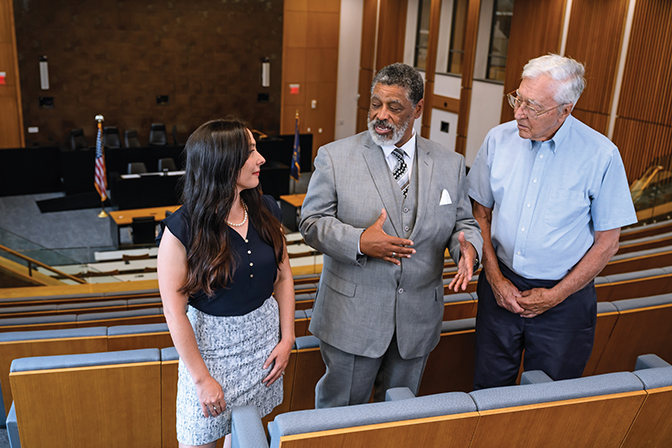
Photo by Zack Thompson
The Secret to College
It seemed like Davis always knew he wanted to be a lawyer, after trading his dreams of being a rocket scientist.
“I decided when I was in eighth grade, I wanted to be a lawyer,” Davis said. “It was locked in at age 13, and by the time I reached 11th grade, I had not changed my mind.”
However, growing up in the deep South during the Civil Rights Movement, Davis said he didn’t have any African American lawyers to look up to.
“The African American professionals in our neck of the woods were undertakers, pastors, a few schoolteachers and people who owned their own businesses, like small-town grocery stores,” he recalled. “And they were not educated people. They were not people with master’s and doctorate degrees, which I didn’t know anything about.”
Davis had attended an all-Black school from kindergarten through seventh grade. During his eighth-grade year, he and four other students from Eastside Elementary School went to the predominantly white Dixon Junior High School as part of Martin Luther King Jr.’s desegregation program.
Berea tempered me and disciplined me. It had the structure that I needed.
William Davis ’74
Davis’ mother didn’t want him to go, but he insisted, and eventually attended the predominantly white Talladega High School, where he participated in the Upward Bound program. Through the program, he took college-level classes and visited college campuses. Participants had access to take the PSAT, SAT, ACT and National Merit Scholarship tests. Thanks to the program, he aspired to go to college.
During his junior year of high school, he was called into the guidance counselor’s office. Worried he had been accused of something, Davis went in on the defensive, only to find out he had scored high enough on those tests to attend college.
There were obstacles, though. Davis’ family had a low income, and the school principal had already spoken with his mom, convincing her she would never afford to send her son to college. The principal had also instructed the school staff not to help Davis or any other Black students with anything related to college.
The guidance counselor, however, knew of Berea College and was convinced Davis would be a good fit. She offered to help him but swore him to secrecy.
“She said, ‘I got a place for you. You’re a good talker, and I think you’ll make a good lawyer. I’m going to help you, but you can’t tell anybody,’” Davis said. “She said everything had to be done in confidence. I couldn’t tell my mom, my friends, my teachers, anybody.”
Davis took home a pamphlet about Berea College and scoured it that night, learning that all students are from modest incomes and had to work and maintain high academic standards and, based on the picture on the front, there was snow.
“But the thing that really clinched it for me, besides the snow, was that I read that John G. Fee, a minister and abolitionist, started this college for Blacks and whites,” Davis said.
Meanwhile, the guidance counselor was securing letters from other teachers and the other necessary documents to get Davis into Berea. Davis kept that secret long enough to graduate high school. In fall 1971, he arrived at Berea College.
While at the College, he served on the student council and was senator for his dormitory. He worked as a bus boy at Boone Tavern, a janitor at the preschool and at the library shelving books. He managed to graduate in three years and was accepted to UK law school, thanks to letters from professors who had also helped Lawson get into the school, he said.
After law school, Davis joined the U.S. Air Force. He attended military law school and worked with the Judge Advocate General’s Corps, where he helped prosecute military crimes.
He went on to become a civil rights lawyer and has practiced in Kentucky for most of his five-decade career. He also taught courses at Kentucky State University and the Kentucky State Police Academy. Eventually, he worked as an assistant deputy attorney general and director of the uninsured employers fund in the Kentucky Attorney General’s Office. He was the first African American in these positions in the history of the Kentucky Attorney General’s Office. In 2024, he was inducted into the Kentucky Civil Rights Hall of Fame.
Davis attributes much of his success to his Berea experience.
“Berea tempered me and disciplined me,” he said. “It had the structure that I needed.”
Davis’ work in civil rights law is what led to his connection with Puckett, and Lawson was the connector.
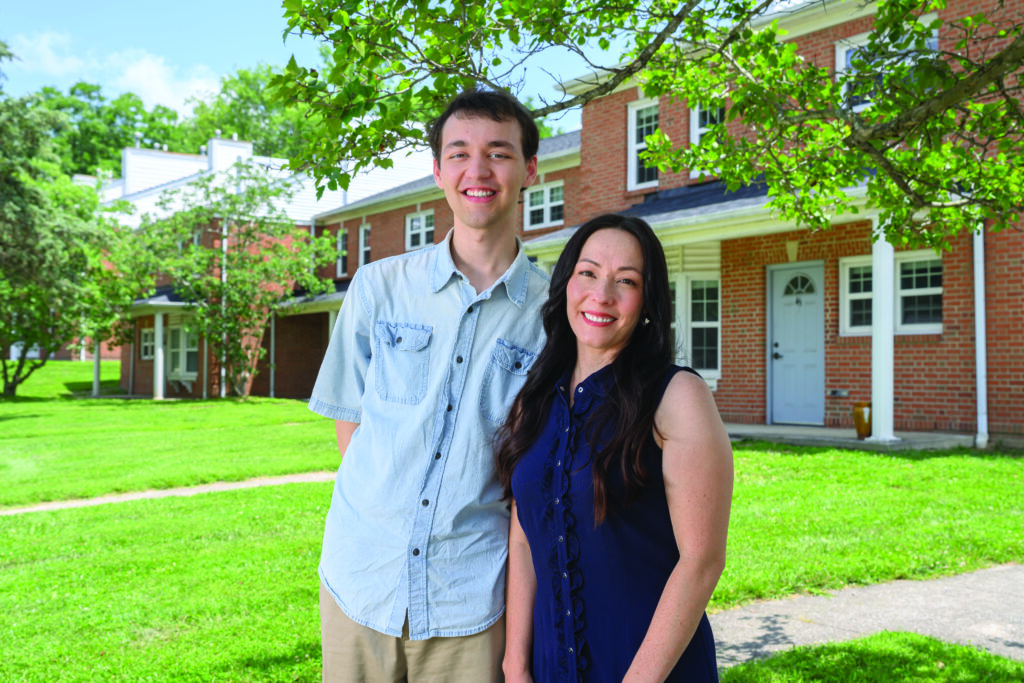
Photo by Brooklynn Kenney
Discovering Her Full Potential
Puckett found herself in law school more than a decade after she graduated from Berea. In her second year at UK, Puckett was writing for the Kentucky Law Journal about Section 1983, which is a federal civil rights law allowing individuals to sue government officials who violate their constitutional rights. Puckett was particularly interested in relief for those who had been wrongfully convicted.
Needing to connect with others who had studied the law, and knowing he was a fellow Berean, she asked Lawson for help. He referred her to Davis, who helped her with the article.
Puckett came to Berea College from Lexington, Kentucky, where she admits she was a bit of a “troublemaker” as a teen. As she neared the end of high school, Puckett was considering either joining the U.S. Army or going to college. As one of 10 children, she knew her parents wouldn’t be able to afford college. Her older sister, Natalie, attended Berea, and Puckett thought it would be a good option for her, too. She scheduled one interview with the Berea College admissions department and knew from then on, she would be a Berean.
“After that interview, I knew that I wasn’t going to apply anywhere else,” Puckett remembers. “And I got that acceptance letter. Berea was huge for me. It was the first place that saw and birthed the scholar in me.”
Puckett said attending classes at Berea showed her what she was capable of. She learned to study, research and write. She had conversations about critical topics with people from all over the world. She worked in woodcraft, as a student chaplain and as a teaching assistant.
“Berea was a really positive experience for me,” she said. “It woke me up to the idea that I could do this more. I could keep going to school. That there was that potential in me.”
Puckett met her husband, Kevin ’06, at Berea, and they had their first child, Benjamin, while they were both Berea students living at the Ecovillage. Benjamin is now a senior at Berea College.
The fact that Berea takes a student’s lack of resources, lack of whatever else, and is able to turn it into an asset is what makes it such a special place.
Emily Puckett ’07
When she graduated from Berea, she thought about law school, but the couple opted to build their family and let Kevin pursue his master’s work. They now have six children, some biological and some adopted from foster care.
Over the years, she kept toying with the idea of going back to school. Having majored in communication studies at Berea, Puckett considered pursuing a master’s degree in that area but continued to feel a tug toward law school, partly because of an independent study she did involving adoption law while she was at Berea. She was also inspired to pursue law because of a childhood friend’s experience with incarceration and helping him with his case, and her own experiences with child advocacy and the foster care system.
So, on a whim one Saturday morning, she took a free practice LSAT test.
“I had never studied, and I didn’t know anything about the test,” Puckett said. “But I got a score high enough to get into UK just on that cold run. I started to think, ‘Gosh, I could really do this.’”
She was ready to reach her full potential and told her husband, “I want to go to law school, and I want them to pay for it.”
It worked out. She took and passed the LSAT and applied to all the law schools in Kentucky. UK offered her the best package: a full ride plus a stipend.
“I thought, ‘What a gift I could give to those who love me—to reach my full potential and allow them to rest in that knowledge, not that I had all this potential and could be this or that but that I actually did it,’” she said.
During her second year of law school, Puckett worked as an extern for the Kentucky Innocence Project. Simultaneously working on her article for the Kentucky Law Journal, she picked a topic related to that. She started writing about Section 1983, which she described as having a “glitch in the system” preventing relief for those who had been wrongfully convicted.
She visited Lawson at his UK office, and he connected her with Davis, who had argued some significant cases involving Section 1983.
“[Davis] knew exactly what I was talking about when it came to that thorny area of the law that doesn’t really work like it’s supposed to work,” she said. “So, he helped me with my article, reviewing it, giving suggestions and providing me with resources.”
The first page of Puckett’s law journal entry includes a “thank you” for Davis’ time and attention, something Puckett attributes to that special Berea connection.
“All I needed to say was that I was a Berea grad, and that was it. He was going to do whatever he could to help me,” she said. “That meant a lot, especially as a first-generation law student. It was helpful to have those connections.”
Puckett, much like Lawson and Davis, said Berea prepared her for law school and to have a different perspective on life.
“The way Berea teaches you to look at things holistically has made me a better attorney,” she said. “And the emphasis on perspective—being able to take yourself out of yourself and put yourself into someone else’s perspective has been invaluable.”
Puckett went on to graduate in the top 8 percent of her law school class in 2024, more than 15 years after graduating from Berea and despite having six children at home. She earned a two-year federal clerkship for a U.S. district judge, drafting opinions and orders. She aspires to work in appeals, where she wants to have influence in interpreting and clarifying laws.
She describes her time at Berea as a gift that she just keeps unwrapping throughout her life.
“I’ve rediscovered several times what’s different about what I had,” she said. “The fact that Berea takes a student’s lack of resources, lack of whatever else, and is able to turn it into an asset is what makes it such a special place.”

Love the article featuring my niece Emily Puckett and my great nephew Ben!