
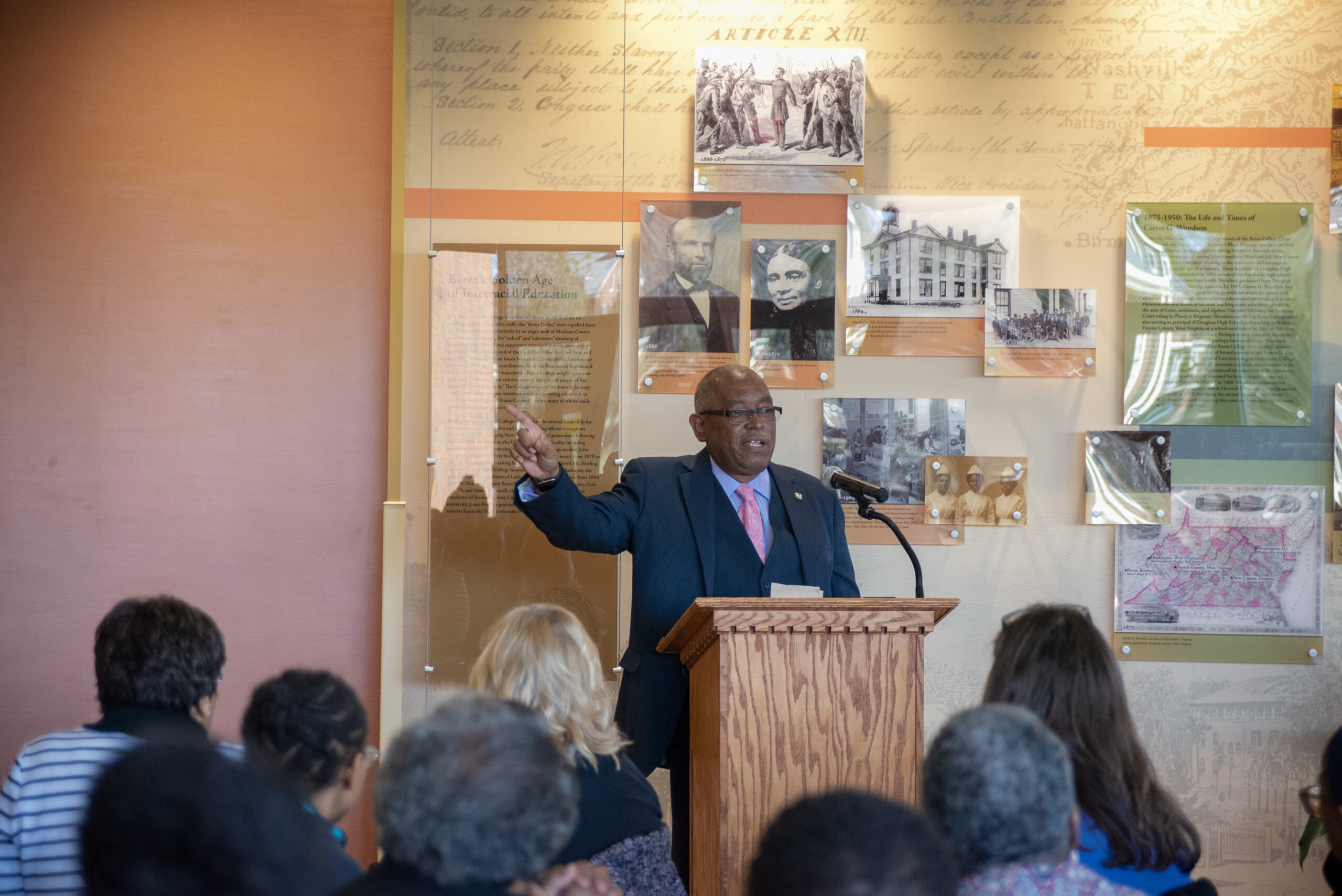
When I left Berea’s Office of African and African American Studies on July 31, 2019, I ended an almost 40-year affiliation with Berea College as either a student or employee. Retiring from Berea College did not mean that I was retiring from teaching. In August, I began teaching at Simmons College of Kentucky, a small, private historically Black college or university (HBCU) in Louisville, Kentucky.
Simmons was a new experience after teaching for 46 years at predominantly white institutions like Ferrum College and Berea College. At least 95 percent of Simmons’ students are African Americans from urban areas. In addition, I commuted approximately 230 miles round-trip, between Louisville and Berea, twice a week. The first semester was a learning experience as the classes at Simmons met for three hours a week, not four hours as at Berea. Thus, I had less time to cover course content. However, the most challenging experience came in March 2020.
Students at Simmons left for spring break and did not return to campus for a year and a half due to the COVID-19 pandemic. During this time, I taught online. Unfortunately, Simmons lacked the technology of Berea College. All Berea College students receive a laptop computer, a device that many Simmons students do not own. Simmons had only a few Chromebooks, and some of my students at Simmons used a cell phone to draft their essays. In August 2019, Simmons transitioned learning management systems—to Canvas from Blackboard. Then, in March 2020, the abrupt change to online teaching required students and faculty to learn how to navigate Zoom.
In 2019, Simmons did not have any residence halls, so all students had to commute; some used Uber and TARC. Because landlords threatened to raise their rent or evict them, students often prioritized work over academic obligations. Despite all the challenges of teaching at Simmons, except for family health issues, my tenure at Simmons would have lasted past 2022.
Simmons students face different challenges than students at other schools, such as Berea College, but there is less complaining. Being around other African Americans compensated for the lack of technology and financial resources. They are happy to be in the majority. Everyone can be “unapologetically Black.” Even non-Black faculty and staff at Simmons understand that the students do not want to “code-switch.” This attitude also existed at Kentucky State University, where I taught for one semester in 2023. As a Berea College student said when I announced that I would be teaching at Simmons, she believed that I would recover my soul at Simmons. She may be right. At Simmons, I could also be unapologetically Black.
If I could return to 2019 with the knowledge that I now have, would I retire and end my Berea journey? The answer would be an unqualified “yes,” even though not all aspects of my learning curve at Simmons were positive. Still, I learned from teaching at Kentucky’s two HBCUs that I was born to teach. It is 2026, and I still miss teaching. I miss grading papers, class discussions and student interaction. However, I do not miss the faculty meetings, the whole issue of assessment and the administrative work.
Retirement can be scary. For too many people, they retire and wait to die. In contrast, retirement rejuvenated me. The flame of teaching glows as brightly now as it did when I walked into a classroom in Garber Hall at Ferrum College in January 1973. More than 50 years later, and despite possibly never teaching another college class, the fire to teach glows brightly in retirement.