

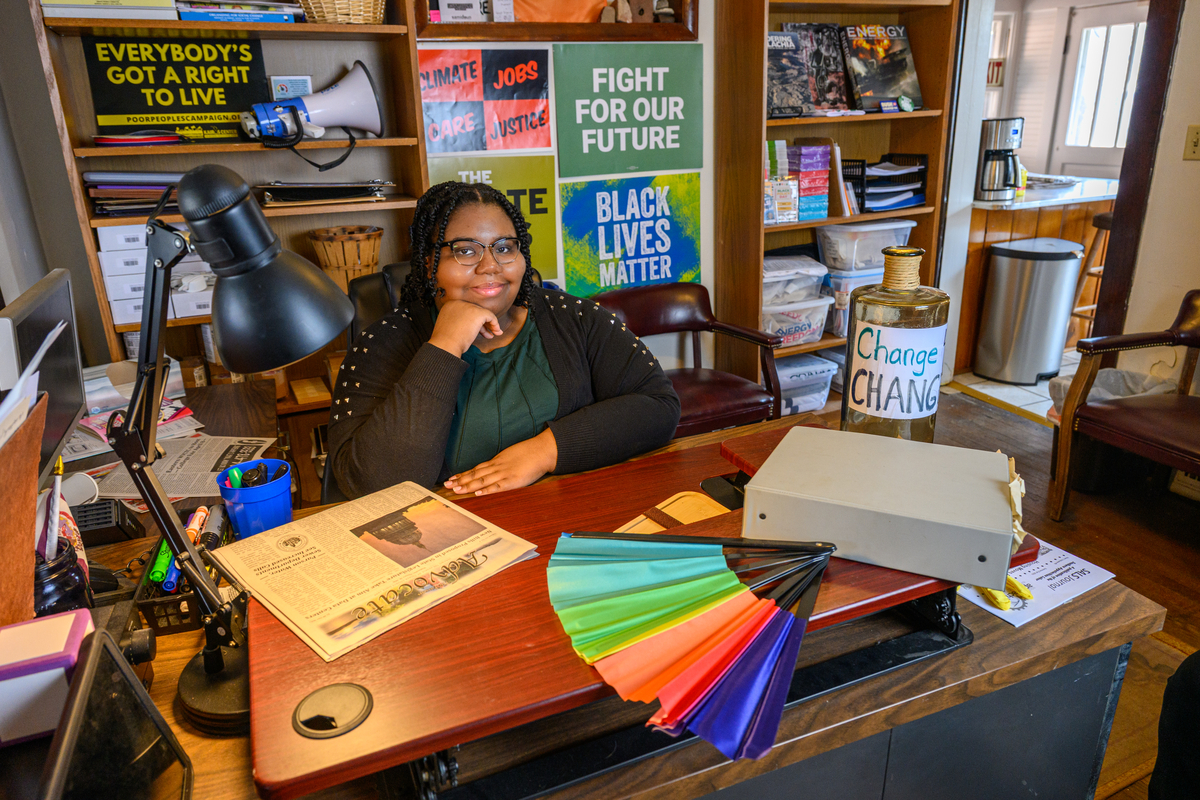
A-Nya Badger ’23 believes she always had a strong sense of justice. She remembers her first step into activism when she was 3 years old. After an incident of police brutality in her hometown, her father took her up to Charleston, West Virginia, to join a march in protest.
“My dad had taken me, and I didn’t understand what was going on,” she recalled, “but I was really taken by the chant. I had my little sign up, and I was so excited. I didn’t understand fully, but I knew something bad had happened, and that it wasn’t right.”
Badger grew up in Kanawha County, also known as “Chemical Valley,” in Dunbar, West Virginia. There, she faced racist remarks and the harsh effects of pollution. “Honestly, it was kind of miserable,” Badger recalled. “It really was, especially being a young, nerdy Black girl in a mostly white area.”
While the harsh effects of her environment were pushing her down, she found inspiration in seeing activism in various media. “Growing up with a slew of books and movies like “The Hunger Games” and “Divergent,” this trend of fighting the government showed me I could make a change.”
During her high school years, Badger immediately got to work. She joined the Stay Together Appalachian Youth (STAY) Project, an organization focused on connecting Central Appalachian youth, building community and inspiring leadership. She later became an advisory board member of Black Appalachian
Young and Rising (BAYR), a Black autonomous youth program that the STAY program is currently incubating.
Badger also became involved with Rise Up WV’s Youth Organizing Division, a program dedicated to empowering youth through progressive activism. There, she organized around the opioid epidemic in the state during 2019. Her work helped change a state law in West Virginia regarding drug felons being barred from receiving SNAP benefits. “Coming off of that, I felt like I was in charge of the entire world,” she said.
Badger’s passion for activism aligned perfectly with the vision of a certain Berean. Throughout her high school years, from her school and her church, she had heard about a college in Appalachia that offered tuition-free education. Badger was very skeptical at first, “It sounded too good to be true,” she said.
Badger believed she would be heading to a local college in West Virginia, but changed her mind after being nominated for the Woodson Scholars Award, which honors exemplary high school juniors from low-income households who exhibit academic excellence, leadership within their community and embody Dr. Carter G. Woodson’s mind and spirit by providing them access to Berea College’s No-Tuition Commitment Scholarship and an invitation to preview the College.
“I got invited to be nominated for the Carter G. Woodson Award; this was the third or fourth time Berea had been mentioned to me within a very short period,” Badger said. “I decided to go, and I absolutely fell in love with the campus, the opportunities and the feeling of being there at Berea.”
Badger would take full advantage of Berea’s opportunities. While pursuing a psychology major, she added peace and social justice to her majors to deepen her understanding of activism. “My environmental justice class really gave me a clear understanding of how various issues interconnect with one another,” she recalled. She also continued providing support for others as a student chaplain in her gender-inclusive residence hall. “I really wanted to carve out space for queer and marginalized people to at least have a little shelter of protection or be a welcoming presence that isn’t judgmental or hurtful to them,” Badger explained.
After graduation, Badger initially wanted to go somewhere else to live her life. But a lack of resources and job options in her field made her reconsider. She thought, “I could stay in my home state around the people that I love, who make my life rich in other ways.” Badger struggled with finding a job in her first year after graduation. “I applied for over 400 jobs in my first year out of college, and the only job prospects
I ended up landing were ones that I had personal connections or relationships with, or like some small stipend in volunteer work. I ended up doing a lot of random things.”
Badger’s long-standing commitment to activism and service, though, became her saving grace. Today,
she is a community democracy coordinator for Fair Shake Environmental Legal Services, a nonprofit law firm that helps underserved people and communities access environmental justice through affordable legal support and education. At Fair Shake, Badger gathers people from various communities and educates them about the democratic levers of power available to them to advocate for what they want to see in their communities. She connects them to legal resources, helps community members navigate protecting themselves from pollutants and turns their dreams for their communities into reality. Badger loves the feeling of winning and helping people go up against these companies. “Last year, we supported a ballot referendum that made it illegal for Pittsburgh to sell, lease or transfer the water utility to a private company,” she recalled.
“What drives me is the personal fulfillment of knowing that I’m putting my effort into opening channels for people who were like me before I got into organizing; people who had this frustration and nowhere to voice it or vent it,” Badger said. “I helped them not feel so trampled by the system.”
Badger plans to continue down an activist path for the foreseeable future within her career and her life. “It feels good to know that I’m doing more than just wishing things could be better,” she said. “It’s also good to see people benefit from the passion and care being put into action.”