
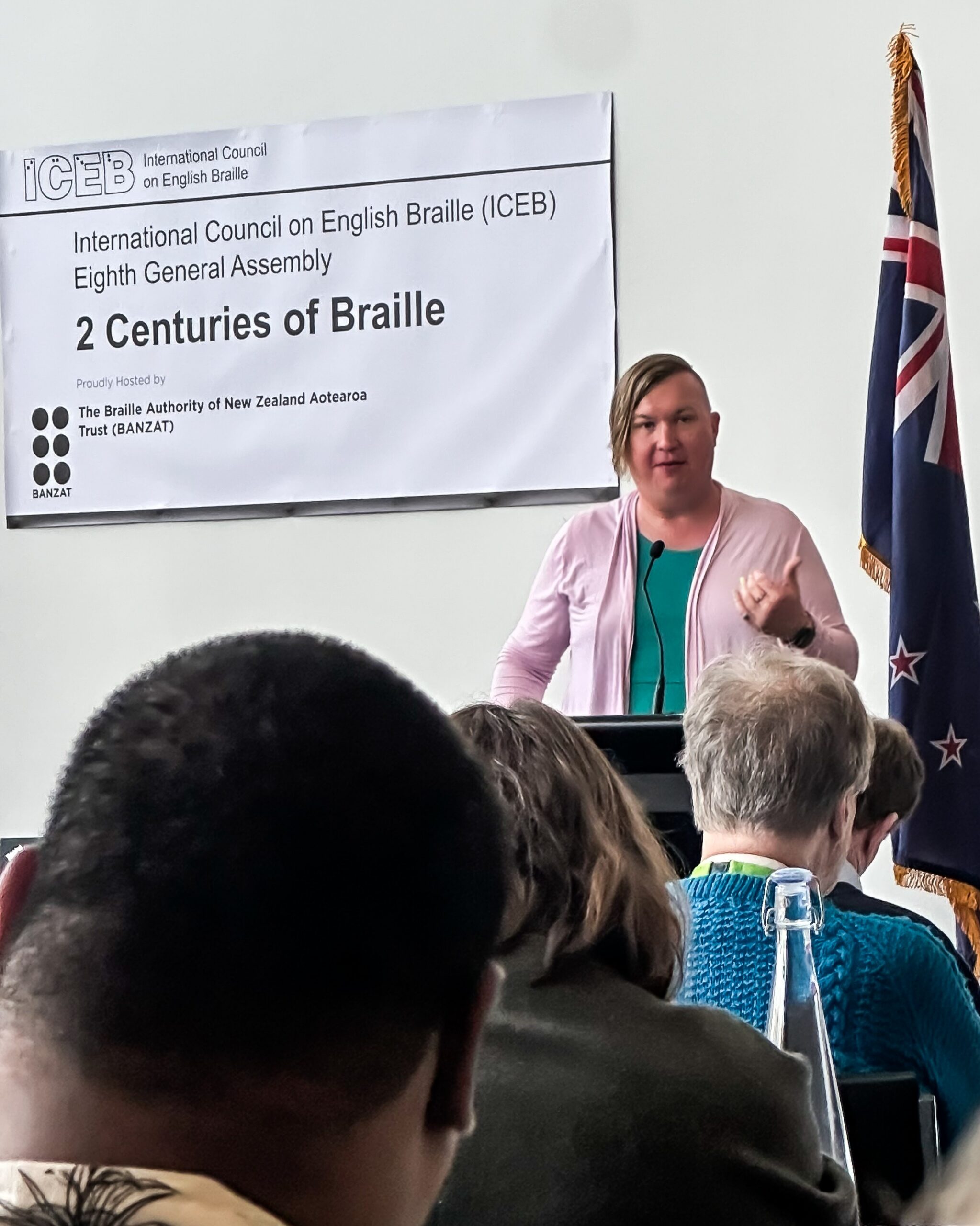
Long before she found herself presenting at the International Council on English Braille, Willow Free ’08 was feeling out a career in grocery store management.
“Nobody in my family had completed college,” she explained. “In my family, success was getting promoted to supervisor.”
Dad was a brake specialist, he worked on tractor-trailers in Louisville. Mom sold shoes before getting on at UPS. And Free was about to get fired. Winn-Dixie was closing stores all over, and young Willow needed a new direction.
“I wasn’t going to college,” she said. “I always made good grades, but it didn’t seem like an option. I didn’t know how I was going to pay for it.”
And she hadn’t given it much thought, really. In the world she knew, college was merely a concept like a foreign land that lay far beyond the Louisville horizon. But then she learned a friend from high school got into Berea College, a place she hadn’t heard of, and he could somehow afford it. His acceptance flipped a switch in Free’s mind.
“My grades were better than his,” she recounted. “My test scores were better than his. I was like, ‘If he gets in, I’m getting in.’”
And she was right. Soon, Free was in Berea and majoring in English. She didn’t have any particular career in mind, just wanted to do work that mattered one day.
“I didn’t want to just make money. I knew I wanted to do something good. And I loved Berea. I loved living in the dorms. I loved meeting people.
Willow Free ’08
“I didn’t want to just make money,” she said. “I knew I wanted to do something good. And I loved Berea. I loved living in the dorms. I loved meeting people.”
Free’s first job after college was transcribing braille at the American Printing House for the Blind (APH) in Louisville.
“They paid me to learn braille,” she said, “eight hours a day for three months.”
Reading braille is an exacting and deliberate experience. Just six dots make up the entirety of a code that can tell a story, and a two-dot difference in characters can change everything.
“When a braille reader reads,” Free explained, “they’re reading one character at a time. Some advanced readers can read the shape of a word, but you’re still taking it in very slowly.”
Free’s attention to detail made her good at reading and transcribing. It was a talent developed at Berea.
“A big part of braille is proofreading—noticing a missing dot. It made sense that my Berea experience fit: catching citations, catching commas.”
My number one asset is communication. I give presentations all over the world because of what I learned at Berea.
Willow Free ’08
Braille, of course, was developed in a world not as technologically advanced. Today, it draws skepticism echoed by sighted folks who have come to prefer video over text. Why read a book when you can watch the movie? Free hears similar criticism in her work.
“People will say, ‘What do we need braille for? We’ve got audio.’ No one would ever say that to a sighted kid,” she said. “That kid doesn’t need to learn to read—we’ve got audio books!”
Only the code is different, not the necessity of learning it. “If you don’t learn braille, you don’t learn how to spell, you don’t learn punctuation, and you don’t learn grammar.”
But still, technology marches on, and even the world of braille must keep pace with it. Much of the world’s information is online but navigating it has remained difficult for people whose experience of text is tactile. Eventually, Free’s work at APH turned technological when she helped develop the Monarch, the first multiline braille device that renders tactile graphics, a Kindle for the blind.
In conjunction with this advance in technology, Free chaired a collaboration with more than 50 organizations across 16 countries to develop e-braille, a standardized digital format that enables braille files to behave in the same way as digital books.
“E-braille is based on the EPUB digital publications standard,” Free said, “So that when they open a book, students can now navigate much faster and take advantage of features like links that print eBooks have had for years.”
These days, Free not only translates text to braille; she translates assistive technological advancements to the world, with the goal of getting braille to kids faster and cheaper. Again, she links that to skills she acquired at Berea.
“My number one asset is communication,” she said. “I give presentations all over the world because of what I learned at Berea.”
Free, a former grocery store manager, never set out to be a technologist or an advocate or a person who would speak at conferences around the world. She just followed the next right step and, in the process, built a career around access and dignity.
“The turning point,” she said, “was realizing college was an option. From there, everything opened. Every opportunity led to the next one. And once I realized I belonged in those rooms, I stayed.”
