

Members of the Berea College Bands perform during the CBS broadcast “Listen!” that premiered on Christmas Eve 2016. Berea’s Bands program celebrated its 145th anniversary this past October. (Photo: Chris Radcliffe)
Berea College students have been entertaining their peers, professors and the greater community for more than a century. Whether lighting up the stage with earnest performances and creating elaborate set designs, or coloring the world through beautiful jazz music or perfecting intricate and sophisticated musical pieces, the history of the Berea College Bands and Theatre Department continue to add to the distinct College atmosphere. Both programs celebrated big anniversaries in 2017—145th and 125th, respectively.
We spoke with Dr. James Dreiling, Director of Bands, and Dr. Deborah Martin, chair of the Theatre Department, to get their thoughts on what their respective programs bring to the College and what the future looks like for them.
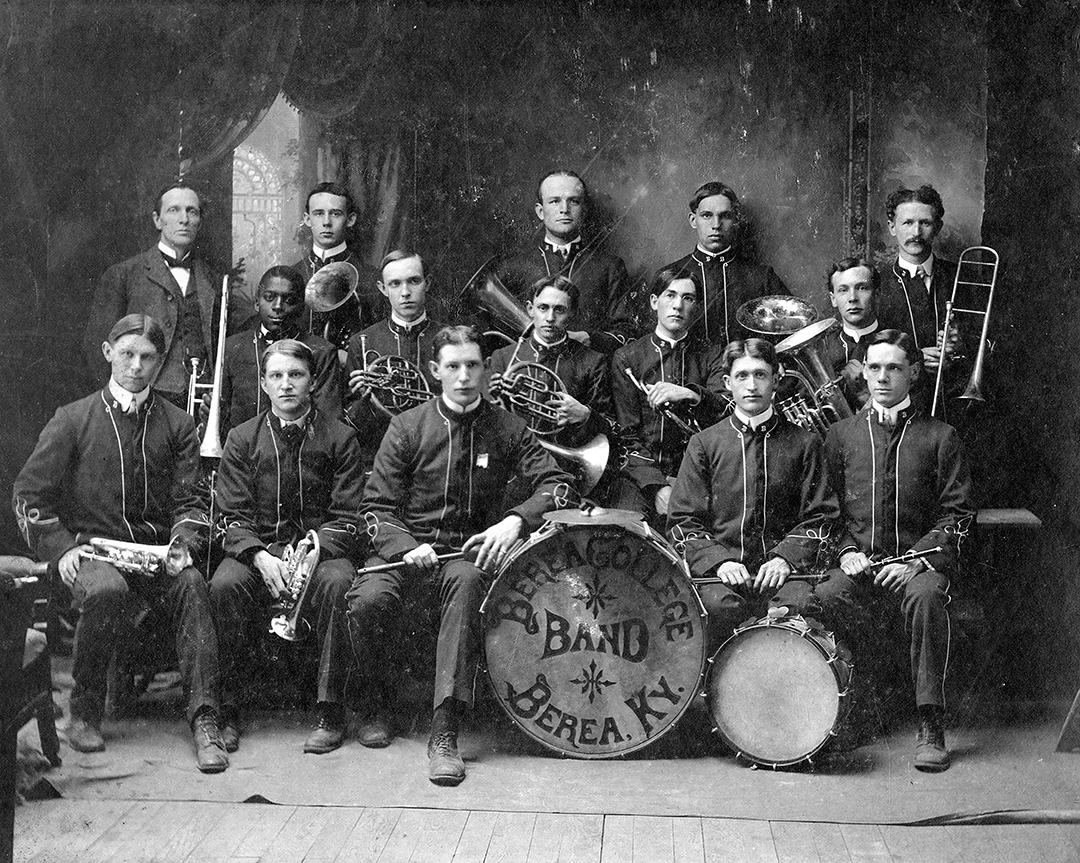
“The band program adds to the Berea College culture,” said Dreiling, who has directed the Wind Ensemble and the Jazz Band for two years. “More than 1,000 people watched us perform in Union Church at the Christmas concert. And more than 4,000 watched us on the live stream.”
Recently, the Jazz Ensemble also performed for a group of Kentucky state senators and the Berea College Board of Trustees at the request of President Lyle Roelofs.
Under Dreiling’s direction, music and music education majors enjoy the opportunity to play in multiple ensembles. The overarching goal for music education majors in the bands is to train in all aspects of performance, including conducting. This spring semester, three students will guest conduct the wind ensemble.
“That’s a very important experience and part of their growth,” Dreiling said, “and helps them prepare to student teach and become teachers in public schools.”
More than 1,000 people watched us perform in Union Church at the Christmas concert. And more than 4,000 watched us on the live stream.
Dr. James Dreiling
Dreiling said he feels the quality of the bands has improved in recent years and is heartened by that. “I’m really happy with the sound of the group, and their technical ability have improved significantly,” he said. “It’s important to find and play music an audience will enjoy, that challenges students to perform at the highest possible level. That’s a really important goal, and they have definitely risen to the occasion.”
Dreiling hopes to grow the size of the program and also to travel, much like with the choral ensembles. With plans to travel to New Orleans in the spring of 2019, he also wants to take the band abroad.
“It’s a little bit harder to travel when you have all those instruments, but it’s possible,” Dreiling said. “I want to create those kinds of music and educational opportunities for our students.”
“Notes” on the Berea College Bands
- A band played at Berea’s first commencement in 1867, but it wasn’t a College band. The first official College band played in 1872, accompanying the Harmonia Society, a campus choral ensemble. It also included local townsmen believed to have been Civil War veterans.
- The earliest bands included only brass instruments and drums. Woodwinds wouldn’t join until the 20th century.
- Women did not perform in the College band until the 1920s. This may have been because women typically studied vocal performance, piano and string instruments. In addition, bands were associated with the military.
- In 1895, J. W. Hughes was paid 50 cents a week to be the band leader.
- In 1898, the band was given permission to play for 45 minutes “on top of Ladies Hall” (Fairchild) after the prayer meeting.
- In 1899, the band was granted permission to charge 15 cents admission to a concert.
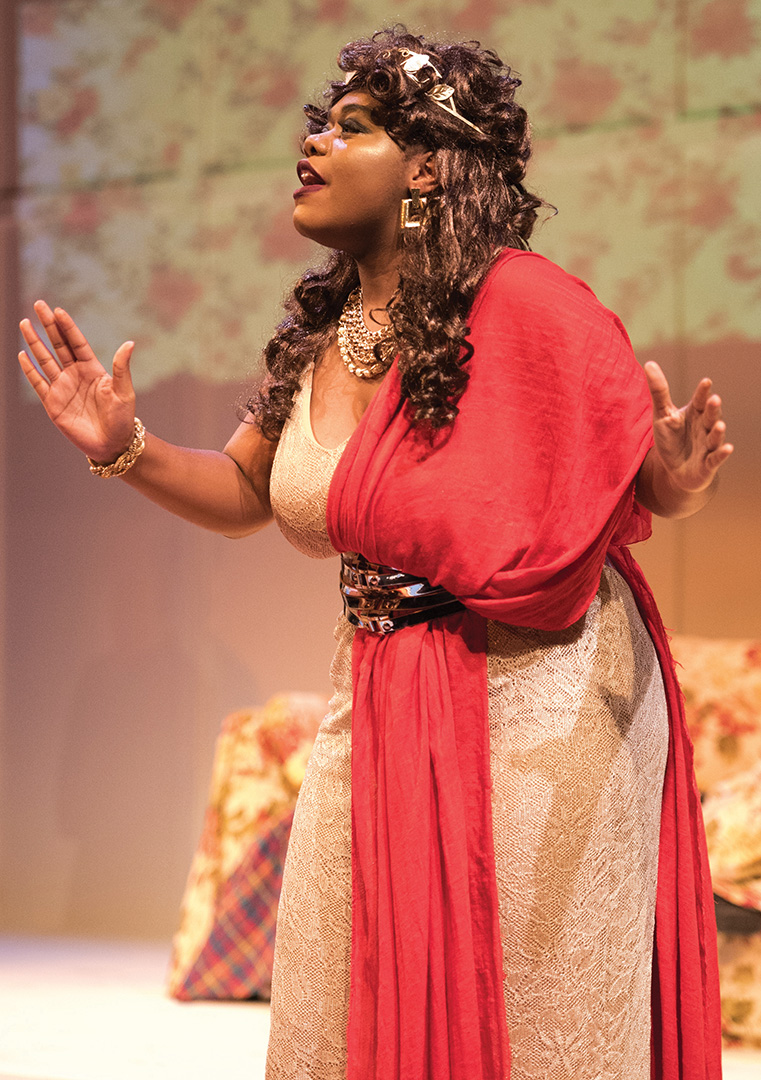
The Theatre Department is celebrating its milestone with a season of shows, including William Shakespeare’s “A Midsummer Night’s Dream,” which was the first play ever performed in the Jelkyl Drama Center in 1980.
“We provide a necessary, I think, social and community spirit to the campus,” said Martin, who, like Dreiling, is looking to grow her program and to educate theatre majors in all aspects of production.
We want to be able to train our students in state-of-the-art technology—lighting, sound and costuming.
Deborah Martin
Where bachelor’s and master’s of fine arts programs focus on specialization—performance or direction or design—Berea students focus on the “and” instead of the “or.” At Berea, “you are a performer AND a technician AND a participant in the front-of-house and marketing operations,” Martin explained.
She tells the story of one alumnus, Stephen Drabicki ’06, who wanted to perform but whose experience in scene painting landed him a job that allowed him to work his way up to performer. Drabicki recently finished touring nationally in the play “Tribes,” by Nina Raine.
Coming to Berea 17 years ago, Martin set the goal of increasing the department’s marketing outreach to involve the community more and to improve the quality of productions. Today, she wants to increase the number of theatre majors and improve technical capabilities.
“We want to be able to train our students in state-of-the-art technology—lighting, sound and costuming,” she said. “It takes resources. More than anything, we want to keep the community spirit of the theatre strong.”
This season’s performances have included George C. Wolfe’s “The Colored Museum,” the rock musical, “American Idiot” and August Wilson’s “Ma Rainey’s Black Bottom.”
