
Walking through the “All Peoples of the Earth” exhibition in the Doris Ulmann Galleries is a way to travel through both time and space while staying firmly grounded on campus. It contains 100 diverse creative works from the College’s permanent art collection. The paintings, ceramics, textiles and prints span 5,000 years of human creativity and every region of the globe. Thematic groupings underscore collective human experiences rather than highlighting differences.
The Storytelling & Myth Making section presents a Salvador Dalí print next to a pair of pink silk children’s shoes from China. In Labor & Leisure, a 19th-century Japanese print of the traditional Boy’s Day contrasts with “Our Land,” a Charles Wilbert White painting of a strong Black woman holding a pitchfork (a loan through the Galleries’ partnership with The Art Bridges Foundation).
The Berea College Art Collection contains more than 16,500 artworks and is the largest university art collection in Kentucky. It includes some significant artifacts, like 19th-century American landscapes by esteemed artists Thomas Moran and Henry Ossawa Tanner. The Samuel H. Kress Foundation selected the Galleries as a repository for a series of Italian Renaissance paintings. Contemporary artists Wendy Red Star, Kara Walker and Alison Saar also are represented.
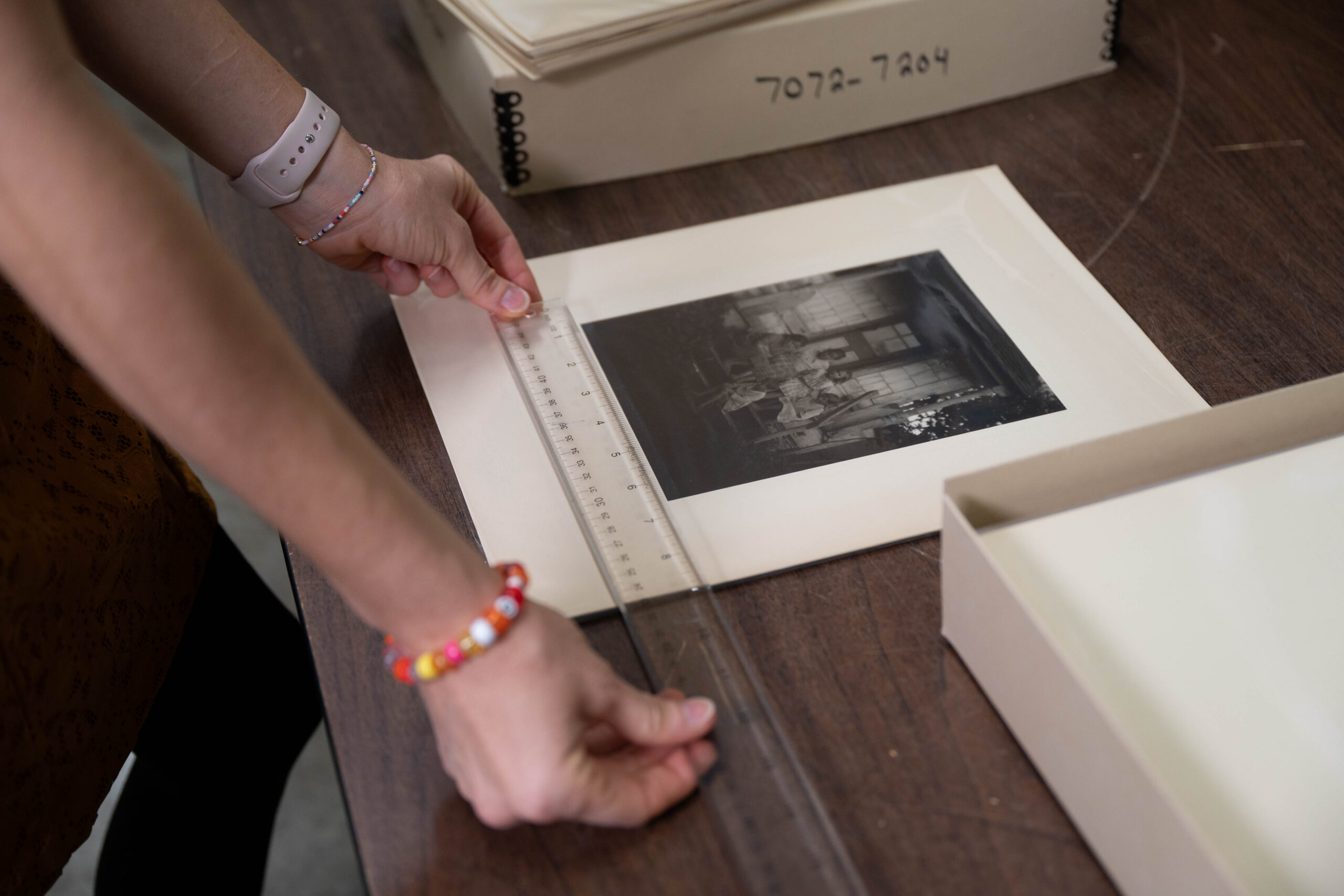
In addition, the collection holds several thousand pieces by the museum’s namesake artist: Doris Ulmann. A preeminent 19th- and 20th-century documentarian of Appalachia, her photographs captured everyday life across the region.
Photos by Niema Hussain ’27
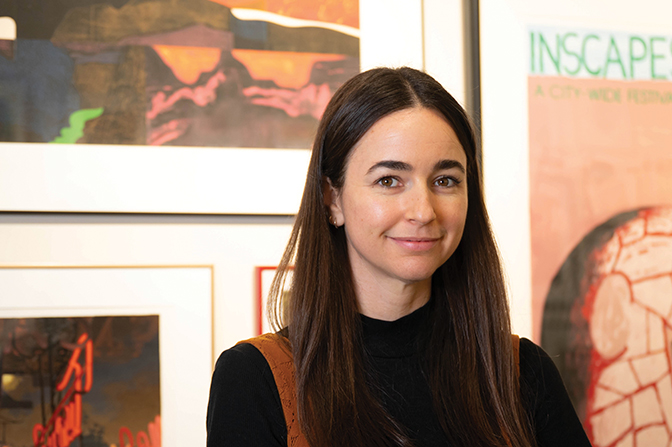
The collection is still in development under the stewardship of Gallery Director and Curator Dr. Kelsey Malone. Most early acquisitions were generously donated by College supporters from their own collections. Now, donors are aiding in filling gaps and diversifying perspectives by funding works made by people of color, members of the LGBTQ+ community and immigrants.
Established in 1935, the collection is uniquely Berean. Based on the premise that every student deserves a world-class liberal arts education, it is first and foremost a tool for teaching. Students engage with the artifacts through an array of educational opportunities, from introductory workshops on viewing art to preparing and curating exhibits.
That exposure is especially important because many incoming students have never visited an art museum before. Some of that is a lack of opportunity or encouragement. But some is believing art galleries are not places that will welcome them. Creating a space where students belong is central to the work of Dr. Malone and her team.
We want students to feel ownership and agency over this collection created for them. The college is thinking intentionally about experiential learning, and the Doris Ulmann Galleries are one of our learning laboratories.
Dr. Kelsey Malone
“We want students to feel ownership and agency over this collection created for them,” Malone said. “The college is thinking intentionally about experiential learning, and the Doris Ulmann Galleries are one of our learning laboratories.”
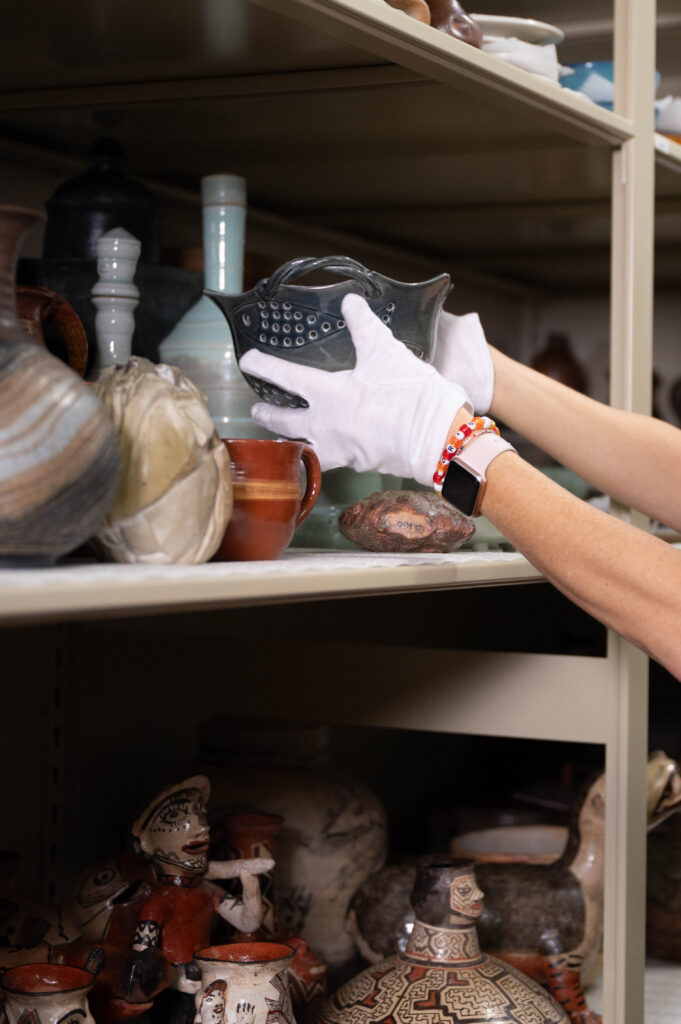
Many students have their first encounter with the Galleries during a class visit organized by BereaCorps Art Collection and Gallery Associate Dante Stewart. She and Malone work together to design sessions based on class goals and objectives, in consultation with the professors. That might feature a tour of current exhibits and a discussion on slowing down and looking critically, or it might involve pulling select artworks from one of the two museum-grade storage vaults and displaying them in the teaching gallery.
Independent research sessions and class visits provide the kind of close examination of artwork that’s not available at other places. That includes direct viewing, without protective glass or frames, and the chance to scrutinize works with magnifying glasses and flashlights. Fine points of technique as well as instances of damage are all part of the conversation.
Art classes visit the Galleries frequently for study and inspiration. But those from a wide variety of other disciplines also access this artistic resource. In the last year, professors of religion, biology, political science, English, child and family studies, and health and human performance have benefited from the collection.
Dr. Jeff Richey, professor of Asian Studies, usually brings three classes a year to interact with the collection. The senior Asian Studies research seminar visits at the beginning of the semester to explore the potential of studying objects in the collection. The students in his introductory China and Japan courses visit towards the end of the term as a kind of test. As they view Buddhist iconography or Shinto imagery, he asks them to apply what they have learned in class and demonstrate their grasp of visual literacy.
Photos by Niema Hussain ’27
“I use a lot of visual culture in my courses because I want students who study abroad in Asia to have some cultural competence about the objects they see in museums and temples,” he said. “Some of the collection’s East Asian artifacts are really priceless, and the Galleries are competitive with any museum collection in the world.”
Dr. Richey described some premier examples. One is a 2,000-year-old Han dynasty coin. Another is a series of prints from the Japanese Edo period, from 1603-1868, featuring celebrities, geisha and actors. He recalled that a visiting specialist in prints from that period was astonished by the dozens of interesting pieces in the Berea collection.
The chance to view, interpret and analyze exquisite artwork is only part of the richness the Galleries offer.
Student artists see their own work exhibited and celebrated beside the renowned pieces of the collection. A blue woven wool textile sample from Berea College Student Industries, now Student Craft, is tucked into an “All Peoples of the Earth” display case. A flexible pop-up gallery regularly hosts work by art students and Student Craft Fellows. As graduation approaches, capstone shows by senior art studio majors fill two galleries usually set aside for visiting artists.
Students who work in the Galleries gain valuable, practical experience in collections management and exhibition design. Learning to care for artwork and planning events prepares them for future careers in fields like public art or cultural heritage management.
Malone’s spring 2025 Women in Art class discussed the structural barriers women experience to being recognized as part of the artistic canon of the West. She pulled from her own research that focuses on American women photographers, sculptors and illustrators who collaborated to achieve success in a profession that had historically been closed to them.
Together, class members curated artworks from the permanent collection into a museum-quality exhibition of women’s art. “reframing: women artists in the berea college art collection” presented images that countered traditional roles for women. Through archival research on pieces in the collection as part of the curatorial project, one student unearthed the name of the artist of a previously unattributed work.
Our art museum hosts one of the largest free art collections in Appalachia, a vastly underserved region. It’s an amazing treasure and an underutilized resource.
Dr. Kelsey Malone
Throughout her education, Malone always kept one foot in teaching and one in curatorial work. She believes in the imperative of an educational museum and finds joy in teaching art history classes, mentoring work-learning-service students, curating exhibitions and museum outreach.
Offering the Galleries as a resource for the broader Berea community
is a priority. Admission is always free, and visitors are welcome Monday through Friday, while school is in session.
The public is invited to more than 30 gallery programs annually. During the exhibit, “A Meandering Line,” visiting artist Rosemary Meza-DesPlas gave both an artist talk and a workshop on the intricacy of lines. The Galleries partnered with the Forestry Outreach Center for a Tree Week painting party and with the Loyal Jones Appalachian Center for a workshop on crocheting granny squares. At curator conversations, students explained the
methodology and practice behind the exhibits they designed.
“Our art museum hosts one of the largest free art collections in Appalachia, a vastly underserved region,” Malone said. “It’s an amazing treasure and an underutilized resource.”
The final exhibit visitors can see during a tour of the Galleries is entitled “At Home with the Elliotts: A ‘Fine Art Print Collection’ before Berea College.” It’s an homage to Shelly and Gerry Elliott, who have gifted more than 500 prints to the College. Here, many of those in the collection hang on the wall in a near-perfect reproduction of the Elliotts’ home. Pictures hang close together, floor to ceiling, with hardly an inch of wall showing. A large window frames tree tops, illuminated by a light system that reproduces the sun’s angle in Washington, D.C. Low bookshelves hug the walls, stacked with books about the history of printmaking and craft.
The Elliotts chose to surround themselves with what they cherished as beautiful and interesting, and visitors are invited to consider different ways to craft a life in touch with the creative. In a cozy nook with upholstered chairs, the exhibit serves as a living room for the building, a subtle reminder to everyone that they have a home with art at the Doris Ulmann Galleries.