
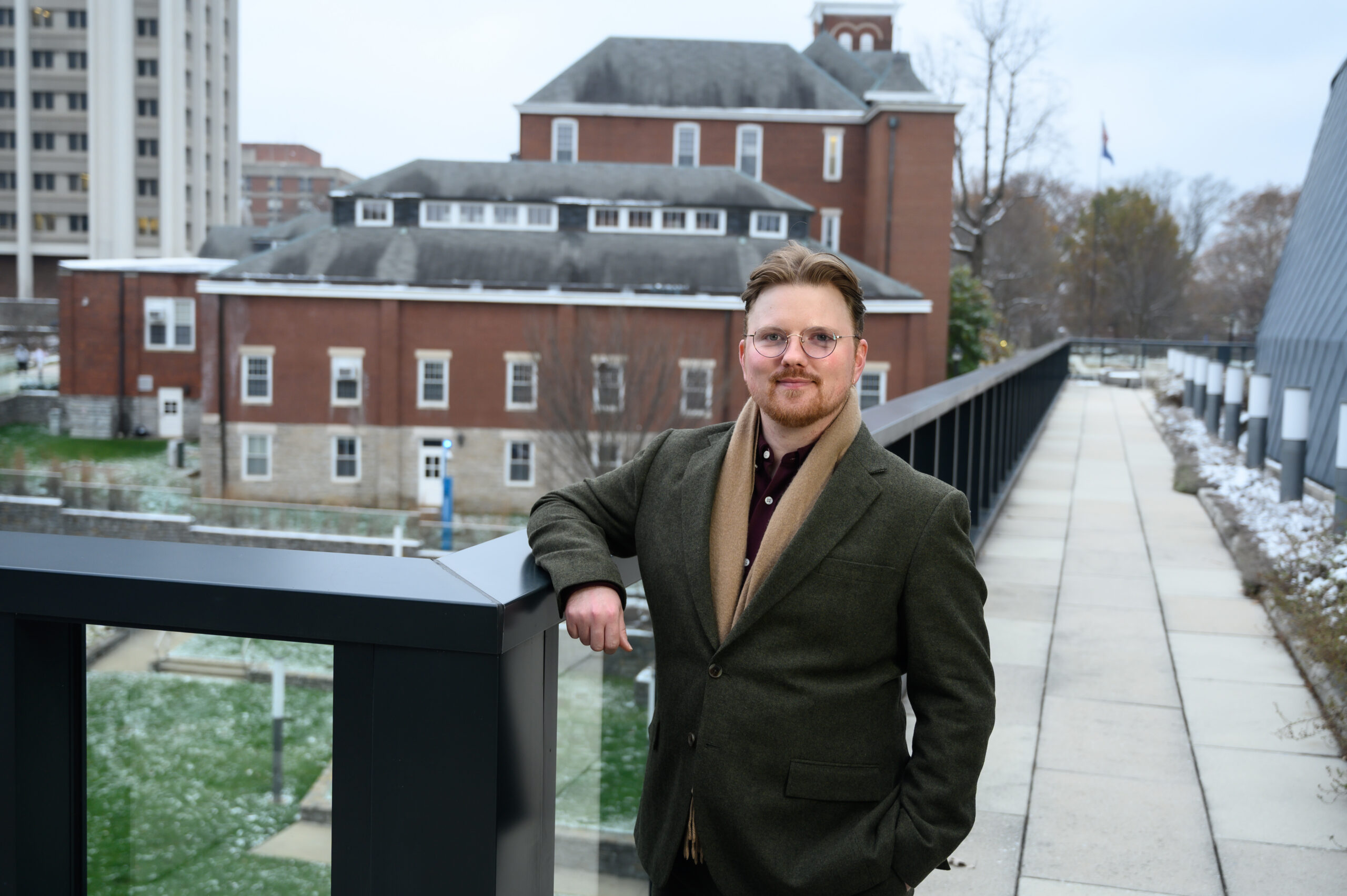
Appalachia has been and continues to be a place of diversity despite narratives of the region being a monolithic culture. This diversity is a focus for Holden Dillman ’17, who is committed to vital research into the mental health and resilience of LGBTQ+ individuals in the Appalachian region.
Hailing from southeastern Kentucky, Dillman majored in sustainable community development. Berea’s unique experience of a small town, liberal arts education is an important aspect of their work today.
“Berea’s no-tuition model made a transformative education possible for me,” Dillman said. “It felt like a place where values, service, learning and equity matched opportunity.”
Even after graduation, Dillman’s Berea education provided the important building blocks necessary for their future projects in social research as they pursue a doctorate at the University of Kentucky’s College of Social Work.
“Liberal arts trained me to connect dots: ecology to identity, statistics to story, policy to lived experience,” Dillman said. “The breadth of a liberal arts education is what lets my work be interdisciplinary, rigorous and useful on the ground.”
The lived experience as an Appalachian and the liberal arts education at Berea culminated in Dillman’s latest project, “We Are Here,” a study focused on the resilience of queer Appalachians.
“Growing up in southeastern Kentucky, I saw how narratives about queer youth often default to risk without naming strengths, love or belonging,” they said.
The name of the study is important and meaningful. Dillman mentioned the focus on resisting common simplified narratives that don’t tell the full story of community.
“‘We Are Here’ is a statement of presence, plurality and place,” Dillman said. “It resists the single-story that frames Appalachian queer life only through trauma by insisting on fuller truths: we are present in every county; we have families, mentors and traditions that sustain us; and we show creativity and care even in hard conditions.”
Liberal arts trained me to connect dots: ecology to identity, statistics to story, policy to lived experience.
Holden Dillman ’17
A lack of research into this demographic was another motivation. Despite recent advancements in LGBTQ+ representation, Dillman mentions an acute lack of research that hinders people’s ability to get the help they need.
The study is aimed at closing the gap in that evidence. It is for queer Appalachians and can play a key role in opening those pathways for individuals to improve their mental health.
“In most national LGBTQ+ research, rural or Appalachian participants either don’t show up in large enough numbers to be analyzed, or their experiences get lumped into a generic ‘rural’ or ‘Southern’ category that treats Appalachia like background noise,” Dillman said.
This is all to combat the narrative that Appalachia lacks diversity. When that idea is applied to LGBTQ+ Appalachians, Dillman stresses that the results can only be negative and do not tell the full story.
“If you only measure trauma, you will only find trauma,” they said. “My study is deliberately refusing that.”
Mental health is critical to saving lives. In the Appalachian region, it can be difficult for LGBTQ+ individuals to receive treatment due to the lack of evidence. Appalachia is a diverse region, and an important part of that diversity is queer Appalachians.
Dillman’s project focuses on tracking mental health patterns of LGBTQ+ Appalachians and offering specific, practical advice to institutions in the region on how to best accommodate them.
“I translate these findings into practical guidance for schools, clinics and youth-serving organizations through briefs, trainings and public resources that can be used immediately.”
Through this research, Dillman hopes the needs of LGBTQ+ Appalachians can be met properly. The first step toward that goal is evidence, research and understanding.
“‘We Are Here’ is both a map pin and a declaration: we exist, we matter, and our stories deserve nuance and investment.”
