
“My story isn’t one of beating the odds; it is one of unwavering support that changed the odds,” explained William Woelki ’22 during his TED Talk as a doctoral student at the University of Delaware in
November 2025.
Woelki has devoted his studies to bringing awareness, through research, to issues such as housing instability and the foster care system. His own lived experiences as a child in the foster care system brought him to where he is today.
“Doing research with children in these systems has allowed me to hopefully show other youth in foster care that their story matters,” Woelki said. “I want to understand and improve the systems that affected my siblings and me by allowing students to understand the systems they are in.”
Student voice is an important part of Woelki’s research, and he has published a few works on the subject. There is one important thing Woelki wants people to know: “I don’t do research on kids,” Woelki clarifies. “I do my research with kids to elevate student voice.”
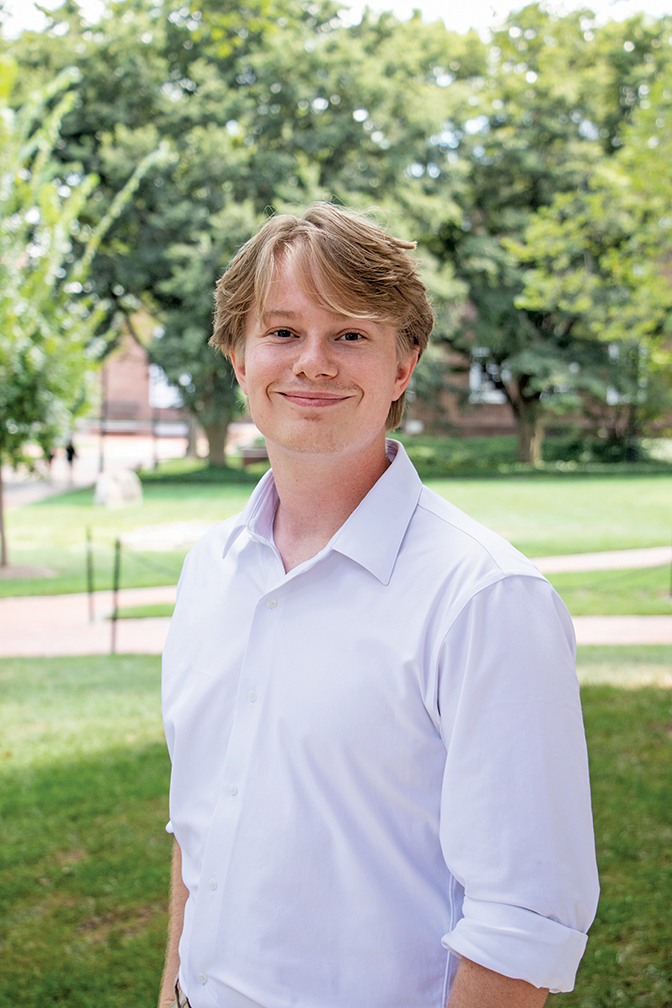
This concept of participatory research allows the participant and the researcher to work together to craft a research question and learn together. This model is important to Woelki because it gives students a voice in their own stories. “A lot of times, people in power will invite students to the table, but they won’t let them talk,” Woelki emphasized. “This methodology creates shared ownership in their own stories.”
Woelki’s story begins like many other Berea College students: he thought Berea College was a scam when he heard the words “free college” from an Upward Bound counselor in high school. “I was sure that Berea would either be a total scam or my golden ticket,” he said.
Curiosity has driven Woelki in many aspects of his life, including researching Berea College. In his research, much more than Berea’s No-Tuition Commitment intrigued Woelki. “I was really interested in the fact that I would work as a part of my experience,” he said.
Beginning as an Information Systems and Services (now IT) support student, Woelki began to create a map of what his time at Berea would look like. “I was a biology major who was certain to go to medical school, even going as far as taking the MCAT,” he recalled.
However, Berea’s liberal arts-education model and work-learning-service experience encourage students to explore their options. Working as a teaching assistant opened his eyes to the social sciences. His last two years, he was an interfaith student chaplain coordinator. “It is just the nature of Berea to allow students to expand their horizons,” Woelki said. “Dabbling in everything at Berea taught me that it is important to find yourself while at Berea. I wanted to expand the campus understanding through interfaith dialogues.”
During his senior year, Woelki decided to add a major in child and family studies to his biology major. “I was fascinated with how humans develop,” he said. “I wanted to search for answers about everyday life. I was approaching the question of human development from two different angles.”
He also realized he did not want to go to medical school. “I found out that I really didn’t like blood,” he explained. “I wasn’t trying to be a doctor because it would make me happy; I was chasing money and everyone else’s ideas for my life.”
Instead of going to medical school, he decided to pursue a Ph.D. at the University of Delaware, where he received a full-tuition scholarship. The transition to Delaware was a time when Woelki was unsure of what the future would hold, but he knew he needed more schooling to be an expert in the field. “I approached the beginning of my Ph.D. program just like Berea. I thought, ‘Let me see what I can get into,”’ Woelki said.
The curiosity that drove me to Berea and flourished while there will lead me through my next chapter.
William Woelki ’22
This attitude has allowed Woelki to find many ways to bring his ideas to life. He is in the last semester of his Ph.D. program, where he is studying human development and family sciences. However, curiosity is still his driving force. “I’m involved in national, state and grassroots advocacy efforts,” he said. “I go to Capitol Hill, where I hope to elevate youth voices on key issues like housing stability and foster care.”
Aside from being an advocate for youth, Woelki teaches classes at Delaware in human development and social work. “I’m really passionate about teaching. It is one of my favorite parts about my job,” he said. “On the first day of the semester and throughout, I explain to my students that they are experts on themselves. No one can take away their lived experience.”
Because of his experience, Woelki was asked to give a TED Talk. He wanted to talk about the youth he advocates for, but he took an approach that avoided a deficit narrative. “I wanted to highlight the strengths of the youth who are a part of the system because we are not individually responsible for what happens to us,” Woelki admits. “If it weren’t for Berea, I wouldn’t have been prepared for my postgraduate career.”
Woelki not only wanted to educate people outside of the system about the youth inside it, but he also wanted to educate the youth inside. While at Berea, he would often watch TED Talks on areas of his life he wanted to improve. “I hope that at least one student who is in the system and wonders if they are going to make it out watches the video and gains some hope that it is possible,” Woelki said.
He does not anticipate a large life change when he graduates from the University of Delaware this spring. “My life will be more of what I’m doing now,” he said. “The curiosity that drove me to Berea and flourished while there will lead me through my next chapter.”