

When one hears “Appalachian music,” they may be forgiven for the image accompanying it in their mind. If the genre inspires a vision of an old, bearded white man in overalls holding a banjo, it might be because that stereotype is the one always carted out to go with it.
The stereotype is old, as Elizabeth DiSavino, Berea College’s associate professor of music and director of the Celebration of Traditional Music (CTM), points out, and is, by nature, exclusive of other kinds of Appalachians. DiSavino noted a particular “hillbilly” presented on the cover of an old CTM festival pamphlet that bothered her and colleagues for years. In a forthcoming book on the subject,
the old hillbilly banjo player serves as an introduction.
“The irony,” she said, “was that he wasn’t a very good banjo player. He said, ‘That woman over there plays way better than I do. Why don’t you take her picture?’”
As though his photo would appear alongside the entry for “Appalachian musician” in a cultural encyclopedia, the photographer for the event assured the man he was the best fit.
“That’s how strong the stereotype is,” DiSavino noted, “white, rural, male. And while that’s one thread, it’s not the whole fabric.”
This image stood in the back of DiSavino’s mind as she prepared for the virtual gathering of the Appalachian Studies Association in 2020. She hosted a panel titled, “Still Here: Music of Other Appalachians.”
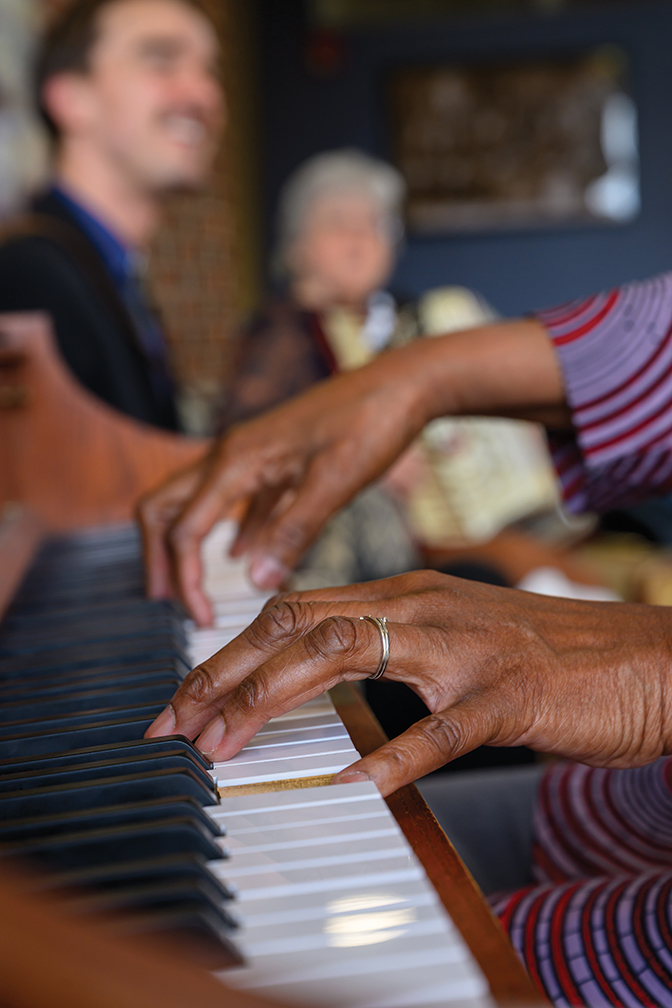
To assist her in pointing to the rich diversity within the Appalachian music scene, DiSavino’s co-panelists included Dr. Kathy Bullock Hon. ’17, Berea College professor emerita of music; Sam Gleaves ’14, director of the Berea College Bluegrass Ensemble; Dr. Deborah Thompson, then assistant professor of general studies and country dance program coordinator; and Dr. Barbara Duncan, a folklorist.
“From that experience,” DiSavino said, “we got the idea to turn what we had discovered into a book.”
Each author of the forthcoming “The Music of ‘Other’ Appalachians” tackled aspects of Appalachian music identity closest to their own experience. DiSavino explored Italian influences in West Virginia, Gleaves fleshed out the LGBTQ+ experience, Bullock traced African American stylings in the region and Thompson explored women musicians. Dr. Duncan covered contributions from the Cherokee.
“In so many ways, Appalachia has been defined by people who aren’t from Appalachia,” DiSavino said. “All of us were writing from within the identities we were studying. That mattered. We weren’t outsiders looking in—we were insiders looking out.”
DiSavino’s contribution is rooted in surprise: an Italian Heritage Festival in Fairmont, West Virginia.
“I said, ‘What?’ I certainly felt like the only Italian in Kentucky,” she recalled.
But West Virginia, it turned out, received the lion’s share of Italian immigrants working the mines.
They stayed and formed lasting communities.
“They established a culture in Fairmont,” DiSavino explained, including an “Italian Radio Hour”
in the 1940s that mixed Italian accordion songs with country and other types of music. “Everybody
in four counties tuned into it on Sunday afternoon,” she said. “That blew me away.”
It made sense, though. Even the most stereotypical Appalachian images carry the influence of the Italians: the violin and the mandolin.
“You can’t have a Bluegrass band without a mandolin,” she said. “The mandolin comes from Italy. And that fast tremolo Bill Monroe does—that is an Italian technique all the way.”
African and African American notes thread throughout the Appalachian music scene as well, Bullock noted. The banjo, for example, is an African instrument. But the legacy is also within the old hymns, the specific syncopations, discoveries Bullock found surprising.
“I thought African American and Appalachian culture and music were totally separate,” Bullock said.
People do have preconceived notions. And there can be compounding otherness put on people because of having different identities. Can you be Black and a woman and an Appalachian at the same time? Of course, but the world doesn’t always make space for that.
Deborah Thompson
But during a visit to Little Dove Old Regular Baptist not far outside of Hazard, Kentucky, Bullock could hear the fusion in the hymns they sang. This revelation led to further research into coal camps where Black, white and immigrant workers lived and made music in tightly packed communities. As she delved further, she found African influences again, patterns within the foot-stomping and hand-clapping—and within the rhythms of the fiddle.
“You can hear syncopated rhythms that came from African heritage,” Bullock explained. “The same rhythmic complexities I grew up hearing at my Black church in Washington, D.C. It blew my mind. It’s in the foot-stomping, the phrasing, the feel. Musicians always get together—they always have. Underground in the coal mines, where life was dangerous and everyone depended on each other, people sang together no matter their color. Up above they might have been segregated, but below ground, it was one sound.”
The same spaces above ground often excluded women from the Appalachian music story as well, Thompson added. Their feelings of being excluded were pervasive throughout the interviews Thompson conducted.
“A lot of the women that I talked to felt undervalued,” Thompson said. “If they walked into a music store with their husband, people would ask the husband, ‘Oh, what do you play?’ They wouldn’t ask her. And yet, women have been the carriers of tradition: teaching, singing, organizing festivals, running
family bands. The erasure is cultural, not factual.”
Being outside the image that for so long has accompanied notions of “Appalachian music” creates ground to explore intersectionality that forms braids rather than boundaries.
“People do have preconceived notions,” Thompson said. “And there can be compounding otherness put on people because of having different identities. Can you be Black and a woman and an Appalachian at the same time? Of course, but the world doesn’t always make space for that.”
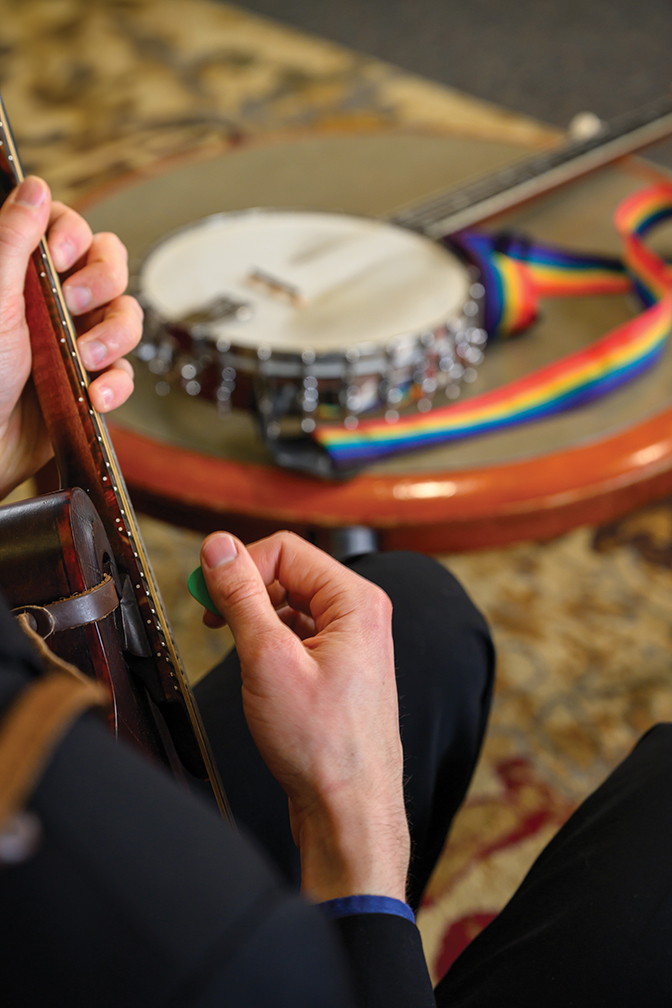
This “compounding otherness” is deeply felt within Gleaves’ portion of the book. Within this section, Gleaves explores the contributions made by LGBTQ+ Appalachian musicians and their careful decisions about the expression of their identities. The recurrent theme among them was a kind of code-switching that happens when artists perform for audiences that hold various attitudes about LGBTQ+ people. How “out” can one be when playing on a picket line beside striking coal miners versus playing for a dance in an urban lesbian bar? The work of Appalachian LGBTQ+ musicians who became active in the 1970s has encouraged younger musicians today to “stand onstage and say who we are.”
This openness is a rather modern phenomenon. It is safer to be out than it used to be. Gleaves, who grew up in the Blue Ridge Mountains of Virginia, remembered how music became a lifeline between cultures and generations.
“When I started interviewing musicians, I asked how being LGBTQ+, Appalachian and traditional players shaped their lives,” he said. “It amazed me how music helped people be their whole selves. “One musician told me that because they played music, their family loved them more. Two trans musicians performed at a family reunion, and that was what made everyone’s day. Music bridged the difference.”
Bridging differences, not merely exposing the existence of “other” Appalachians, is at the core of this work. By highlighting the contribution of others, DiSavino and her fellow authors hope to paint a more diverse image of Appalachia than the world may notice on its own.
“It’s all about othering,” DiSavino said. “It’s all about looking at somebody and saying, ‘They’re not one of us,’ which is something the country is still struggling with. The most fascinating thing to me was how many themes played out simultaneously in all the areas, issues of identity, exclusion, assimilation. People belong to more than just one culture.”
