
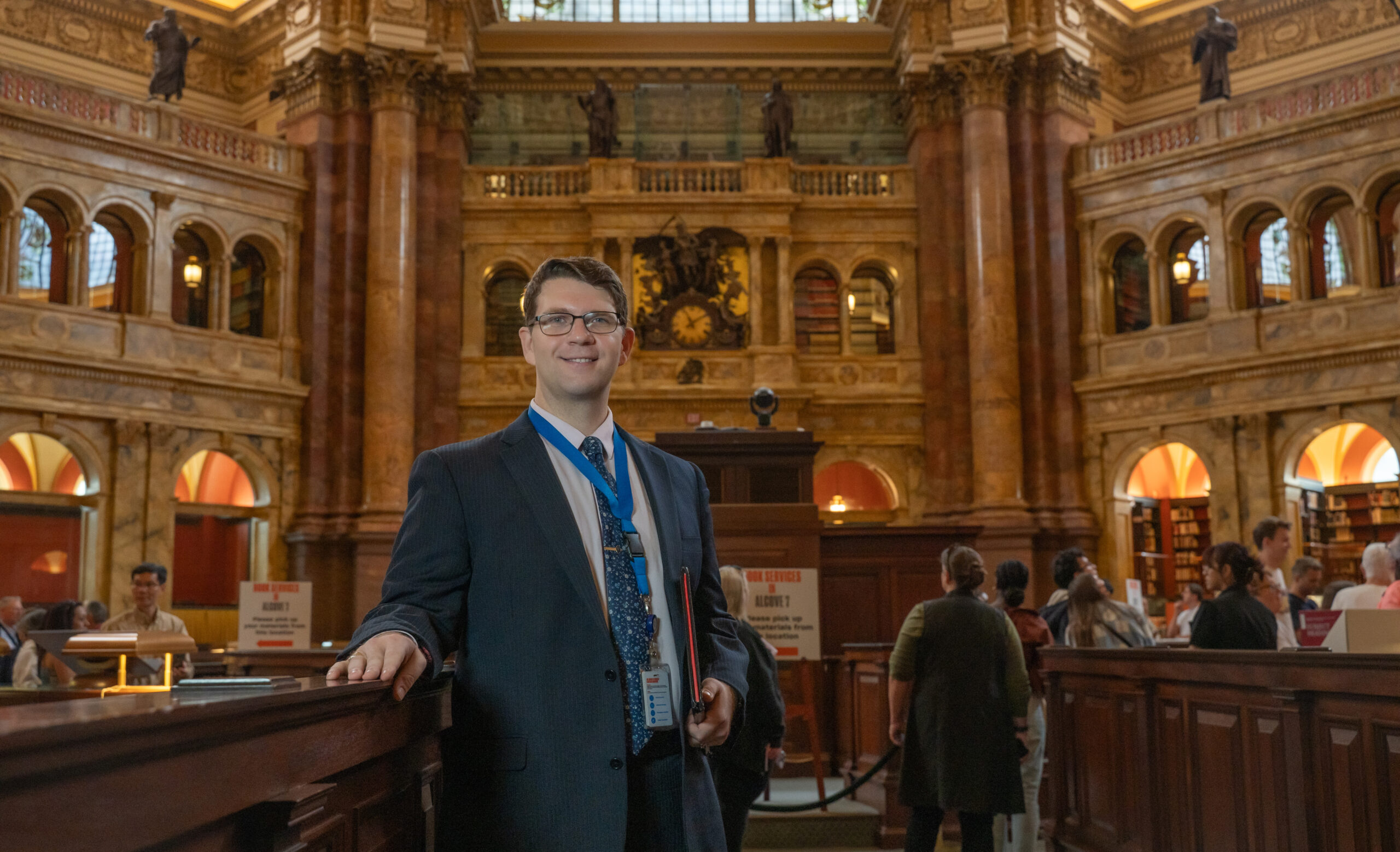
Sidwell Ferguson-English wasn’t sure at graduation in 2011 where his political science degree would lead him. Turns out it was to the largest library in the world, the Library of Congress in Washington, D.C., as the Records Management Division chief. The alumnus finds the position a perfect meshing of his passions for civic life and servant leadership, both bolstered while a student at Berea.
A giant lit torch tops the Library of Congress building. It burns as a constant reminder to keep the flame of knowledge alive. Focused on research, the library has a broad mission to provide information from around the world to Congress and the American people. Its librarians receive thousands of new items for the collection each day. Its international satellite offices seek out rare books from every nation.
Records management is the practice of documenting the business of the government. Ferguson-English and six staff members ensure compliance with the Federal Records Act so government agencies and taxpayers can access the library’s wealth of information. He manages a network of about 100 of the library’s 4,000 employees and coordinates with senior leadership at the library and directors of different agencies.
Ferguson-English has been instrumental in the library’s transition from paper records to electronic ones. A million points of data from important research are now digitized and accessible thanks to this modernization. In a recent analysis of records management work by the National Archives, he and his team were named leaders in the field and years ahead of those in other federal agencies.
Reaching up
Reaching this level of leadership and responsibility wasn’t predictive from Ferguson-English’s background. His parents have struggled with underpaid work and issues with the police, drugs and mental health. The fear of being stuck in his family’s low economic status served as motivation to reach for something better for himself.
Inspiration, in part, came from Ferguson-English’s grandfather. He also worked in Washington, D.C., in the Pentagon, and bears a strong sense of civic duty. He vividly recalls candidate John F. Kennedy visiting his rural Appalachian school. The politician asked the students what they needed to be successful. Kennedy listened and ensured boxes of books arrived at the school after his election to the presidency. Ferguson-English’s grandfather realized that engagement in the political process was the way to have a voice in national affairs.
“My grandfather was the son of a coal miner who joined the military and [earned] a bachelor’s degree,” he said. “He believed knowledge is the thing that levels the playing field, that can let loose of the shackles a low socio-economic class and region can hold onto you with.”
Berea Inspiration
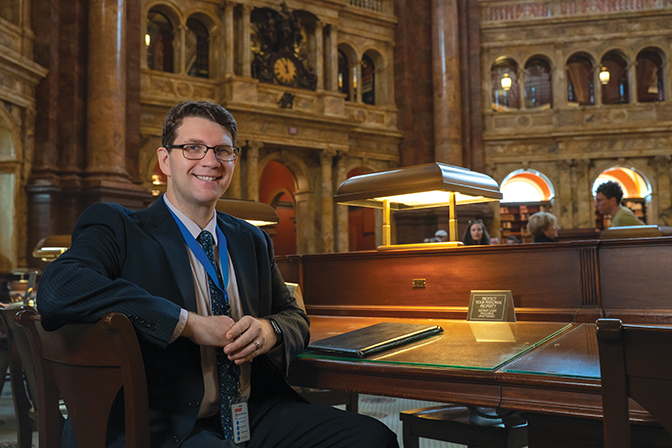
A rich, layered Berea experience helped launch Ferguson-English into a more promising future. After working in food service his entire college career, he achieved the elevated position of student supervisor as a senior. It was a window into a professional work environment and managing people.
Ferguson-English also served as a leader in student government. He was impressed with how well Berea College listened to its students as they successfully lobbied to expand the residence hall visitation policy. Student polls he organized influenced food service leadership to adjust menus and increase sustainability.
“When I was growing up, I knew the possibility of a brighter future in a professional job, but didn’t know how it was achieved,” Ferguson-English said. “Berea provided positive role models for me. They told me even though I was scared, I could do it, and that those kinds of positions were not just for
other folks.”
Career-minded
Ferguson-English attended graduate school at the University of Louisville. With a clear goal of getting out of poverty, he knew he needed to start a career and not just find a job. It wasn’t easy, but he was determined.
“You can’t walk out the door if you don’t turn the handle,” he said. Sheer tenacity drove him to apply for more than 250 jobs before finally landing a position with the Henry M. Jackson Foundation. The nonprofit’s research arm contracted with the Department of Defense to study the benefits of military medicine.
Ferguson-English taught himself Excel spreadsheets in the month before he started the new position, recognizing it was a crucial skill. His ambition didn’t wane once employed. Under his own initiative, he worked closely with the chief of staff to create an internal advisory board (modeled after the Berea College student government) to bridge communication between workers and leadership.
Success with the advisory council led to rapid promotions, from data manager to analyst to senior knowledge coordinator. Then a boutique scientific research consulting firm, Pinnacle Government Consulting, Inc., reached out to Ferguson-English. The firm needed someone analytical, but who could also see how different concepts, projects and people were tied together. He worked there for several years before taking a position with the government.
Ferguson-English was honored to lead a Berea student tour of the Library of Congress last school year. He had specific things he wanted to share with them from his own experience.
“I had trouble reaching out to people, but those of us in the alumni network want to help as a resource,” he said. “You are going to have imposter syndrome, but it is okay. Don’t listen to those thoughts. Trust what you are learning at Berea and take a chance.”