
New Folklife Apprenticeship Program Takes Flight
Stories are the glue that holds cultures together, enabling the passing on of information, tradition and practices. Community narratives can reside in often surprising forms, such as craft, music or even regional foods.
Over the course of her career, Berea College folklorist Emily Hilliard has documented people—like midwives, herbalists, musicians and weavers—who play important roles in preserving and sharing such stories and traditions in their local communities. In 2023, she brought her expertise to Berea College. There, with funding from South Arts’ “In These Mountains” initiative, she launched the College’s first “Folklife Apprenticeship Program.”
“People think of folklore as myths or ghost stories,” she said, “but folklife is really the culture of everyday people. It’s the skills, traditions and creative practices that make up a community’s way of life. As a folklorist, part of my work involves working with communities to ensure these skills and traditions are passed on to the next generation.”
She invited students to apply to work with traditional artists to hone their skills in disciplines of their choosing. The first summer, student apprentices studied blacksmithing, weaving, luthery (making instruments) and storytelling.
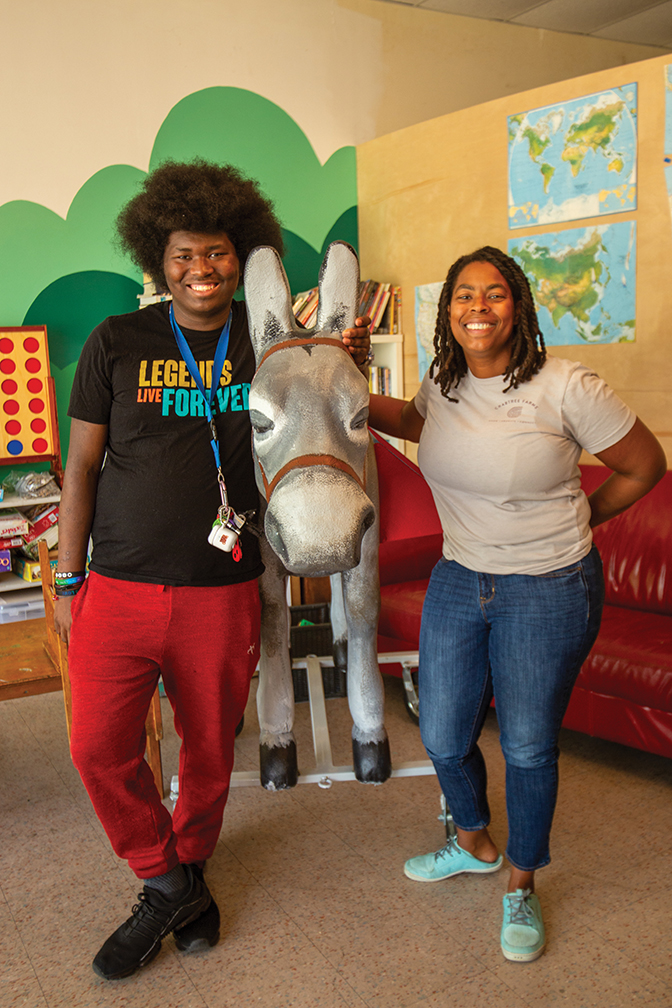
Photo by Emily Hilliard
“As far as I know, this is the first Folklife Apprenticeship Program specifically designed for college students and administered at a higher education institution,” Hilliard said. “Colleagues at Michigan State and Harvard have contacted me, interested in learning more about the model so they might create a similar program at their respective institutions.”
“When I came to Berea, I wanted to build something that connected students to the community through traditional arts. We have so many talented students already — through our Bluegrass Ensemble, Mariachi Berea, and our Student Craft Program — and this apprenticeship complements that beautifully.”
Among the first applicants was Anthony ’27, an English major from Chattanooga. Anthony is a science fiction buff and writer, though he didn’t feel the pull to become a serious storyteller until recently. While considering a career in medicine during the pandemic, Anthony decided he could be of better assistance helping people process their worlds through narrative.
“I realized I’d rather help people emotionally,” he said, “through stories. As a kid, I always imagined scenarios in my head. Over time, that imagination became how I processed emotion, and that turned into writing.”
This way of processing reality, he feels, makes him especially suited to the work. When Hilliard announced that students could earn credit studying traditional art or cultural practices anywhere in Appalachia, Anthony was eager to sign up.
“Anthony told me he wanted to study storytelling,” Hilliard recounted, “and I knew he was from Chattanooga. I told him to look into the Black Appalachian Storytellers of Tennessee group. He did—and he found Jazmine LeBlanc, who basically works in his neighborhood.”
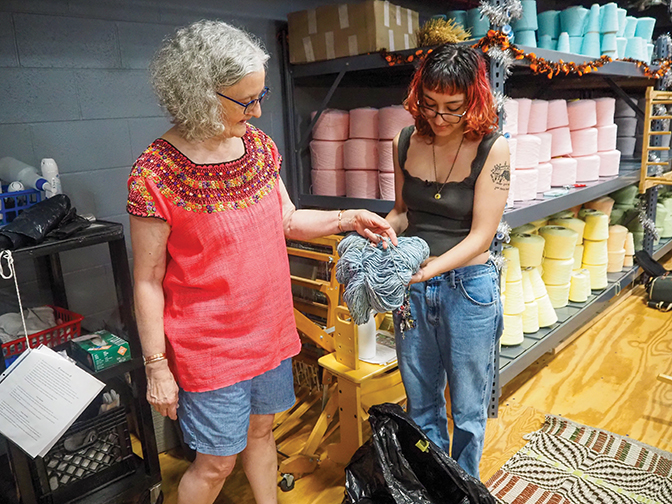
Photo by Emily Hilliard
LeBlanc founded the Ella Library, which Anthony had frequented in the past since he lived nearby. When Anthony emailed about the apprenticeship, LeBlanc didn’t hesitate.
“He reached out about doing a storytelling apprenticeship,” LeBlanc said. “He showed up a week later.”
Their work together focused on oral performance, things like tone, pacing, gesture and posture, “all the little nuances that make someone not just a good yarn-spinner, but a masterful storyteller,” LeBlanc explained.
Telling stories to a group of people also involves body language and consciousness of personal quirks. LeBlanc helped Anthony work his “fidgets” into his presentation so they went with his story, not distract from it. They also worked on slowing down.
“I tend to talk fast,” Anthony admitted. “When I get excited, I want to get everything out at once.”
LeBlanc reminded Anthony of why slower is better. “When you slow down,” she said, “you let the audience enter the story. They stop racing to catch up and start living inside it.”
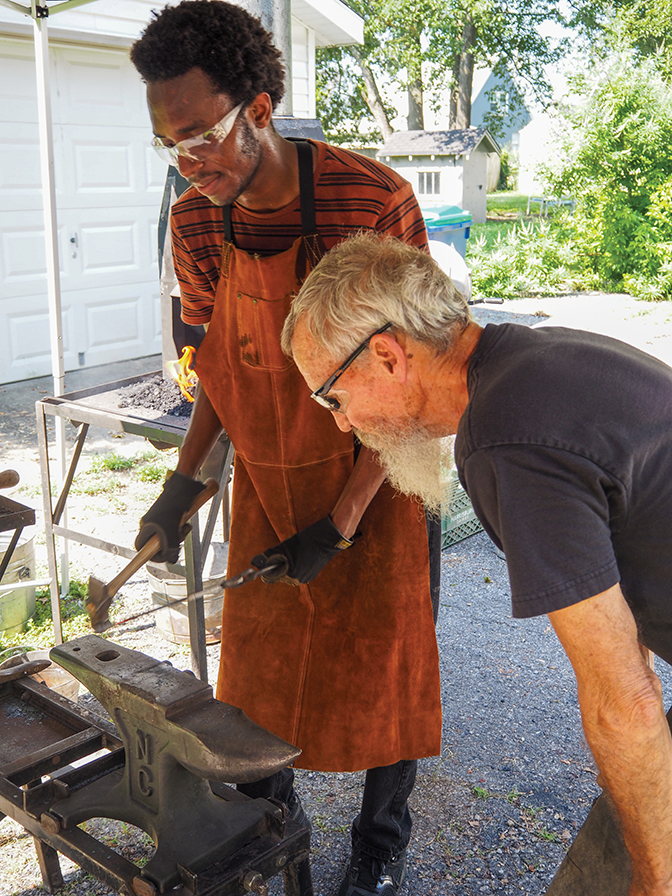
Michael ’28 learns blacksmithing skills from mentor and local artist Bob Montgomery. A Kentucky blacksmith and farrier for more than 50 years, Montgomery has served as a mentoring artist across the state since the early 1990s. He is the owner of Wolf Gap Mountain Forge, located just outside Berea, and his wrought iron sculptural work can be seen throughout the community.
Click here to watch a video of Michael reflecting on his blacksmithing apprenticeship experience.
Photo by Emily Hilliard
The apprenticeship became more than class credit. It was a collaboration. They interviewed regional storytellers, musicians and authors, including children’s writer Rita Hubbard, exploring how African and Appalachian traditions intertwined. But the most rewarding for Anthony was getting to work with Kelle Jolly, who incorporates the ukulele into her storytelling. Anthony even adapted an African folktale, setting it in Chattanooga to reflect his own landscape.
“It was perfect serendipity,” Hilliard said. “He was studying the art of storytelling right in his own neighborhood, guided by someone keeping that culture alive. Students are not just learning skills; they’re finding belonging.”
In addition to that, Anthony also found some useful skills for the future. “Storytelling isn’t just an art,” he said. “It’s a life skill. Being able to speak clearly, connect with people and have them follow you—that’s useful everywhere.”
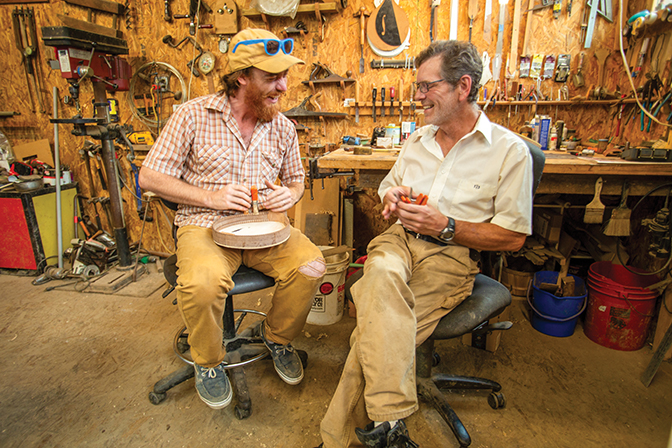
Photo by Emily Hilliard
He is applying these new skills immediately. When the apprenticeship ended, Anthony returned to Berea with renewed purpose. He founded the “Creative Writing Crew,” a student group where peers write short stories together each week. In the future, Anthony hopes to study storytelling abroad in Ireland. And one day, he hopes to find himself working in a library full-time.
“I love libraries,” he said. “They’re full of stories waiting to be heard.”
Hilliard, meanwhile, imagines apprentices becoming mentors themselves in the future.
“It’s been so rewarding to watch students form these relationships,” she said. “In ten years, I can see some of them on the other side as mentor artists themselves, passing on what they’ve learned. Folklife apprenticeship programs like this are important because they are so successful at ensuring these traditional arts and practices are sustained and passed on to the next generation.”
Three of the four mentors in the summer of 2025 were Berea College alumni and included one retiree. The program returned for the fall semester and will again encourage students to preserve and pass on their traditional art forms in the summer of 2026. Hilliard is seeking additional funding to secure the program’s future.
